
I played doubles for almost two years before I understood what pickleball stacking actually was. I had heard the word plenty of times. I had watched partners attempt it during open play and lose track of where they were supposed to be. I had seen it work at high-level matches and look completely seamless, like the two players had some quiet agreement that nobody else was in on. But I did not understand it well enough to use it myself or to know when it was actually the right call.
What changed was playing regularly with a partner who had come from competitive tennis doubles. She introduced stacking into our game gradually, starting with just the serving side, and the improvement in our court structure was immediate and obvious. We stopped ending up in positions that did not suit either of us. Our forehands were where we wanted them. We were not scrambling to recover from positions the score had forced us into.
What I want to do in this article is explain pickleball stacking the way she explained it to me. Not as a complicated advanced technique that only 5.0 players should touch. As a practical positional tool that makes sense once you understand the problem it is actually solving. I also want to be honest about when it is not the right choice, because most articles skip that part entirely and leave players trying to force a strategy that does not fit their game or their partner.
Table of Contents
1. The Problem Pickleball Stacking Solves
To understand why pickleball stacking exists you first have to understand the problem it is designed to solve. In standard doubles, the score determines which side of the court you serve from. Even scores, zero, two, four, six, eight, ten, mean the server stands on the right. Odd scores mean the server stands on the left. This works fine if both players are equally comfortable on both sides. Most doubles teams are not.
Most players have a preferred side. A right-handed player with a strong forehand volley typically prefers the left side of the court because that positioning puts their forehand in the middle, which is where the most balls go in competitive doubles. A left-handed player prefers the right side for the exact same reason. When you have a right-handed and left-handed player on the same team, the ideal configuration puts both forehands in the middle. The score will only produce that configuration half the time without intervention.
Pickleball stacking is the intervention. It is the system that lets you and your partner stay in your preferred positions regardless of what the score is doing. That is the entire point of it.
Without stacking, you are at the mercy of the score. With stacking, you take control of your positioning and make it intentional on every single point. Over the course of a match, especially a close one, that consistent structural advantage matters more than most players realize until they experience it.
2. What Pickleball Stacking Actually Looks Like
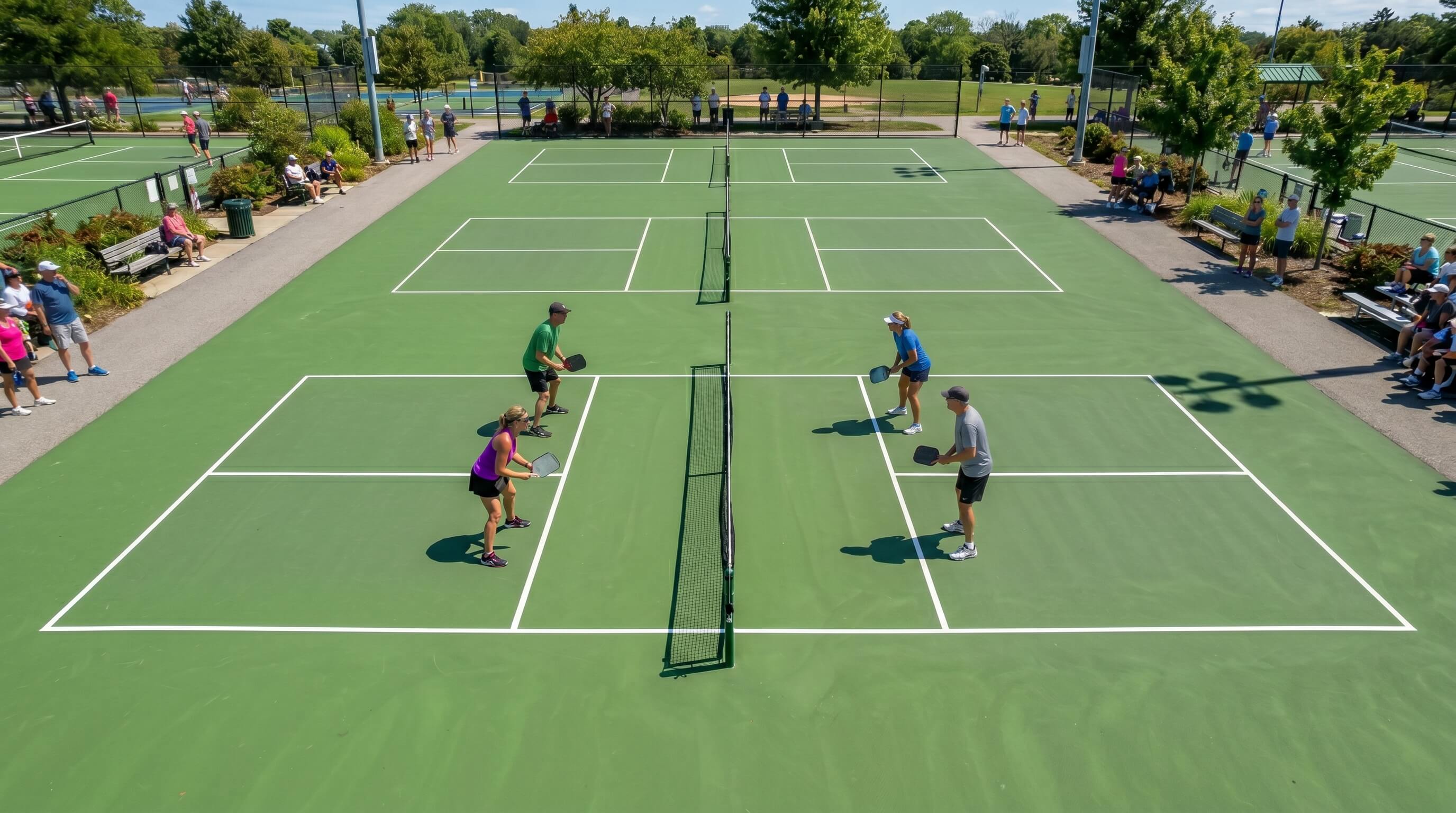
The mechanics of stacking are simpler than they sound once you see them clearly. The basic idea is this: before the serve, both players line up on the same side of the court. After the serve is hit, one player slides to their preferred side and the other takes the remaining side. The lineup before the serve is the stack. The movement after is the unwind.
2.1. Stacking on the Serving Side
This is where most teams start because it is the cleaner version to learn. Let us say you prefer the left side and your partner prefers the right. The score is odd, which means you are supposed to serve from the left. Good, that already puts you where you want to be. But when the score is even you are supposed to serve from the right, which is your partner’s side. This is where stacking comes in.
When the score is even and you need to serve from the right, your partner serves from the right as required. You, instead of standing on the left side in the traditional position, stand behind and beside your partner near the right side baseline. You are stacked. After your partner serves, they let the ball go and immediately slide left. You step into the right side. Within a second of the serve you are both on your preferred sides and the point starts from a structure that suits your team.
To the opponents this looks like: the server served, then moved left, and their partner appeared on the right. From the other end of the court it can look confusing at first. That mild confusion is a small additional benefit but it is not the main point. The main point is that your team is now positioned correctly for the rally.
2.2. Stacking on the Returning Side
The return side is slightly more complex and I would recommend getting comfortable with serving-side stacking first before adding this layer. When you are returning, the player whose turn it is to return is determined by the score in the same way as serving. If the score puts your partner in position to return but you prefer that side, you can stack.
Here the player who is not returning stands outside the court on the preferred side, just beyond the sideline. Their partner returns the ball and immediately moves toward the open side. The non-returning player steps onto the court and takes their preferred side. The key is that the player outside the court is not in play until they step in, which is legal. They are simply waiting in a position that allows them to move efficiently onto the correct side after the return.
The return-side stack requires more timing and more communication than the serving-side stack. Rushing it or miscommunicating produces a moment where both players are on the same side and nobody is covering the other. That is the error most teams make when they first try pickleball stacking.
3. When Pickleball Stacking Is the Right Call
This is the part most articles breeze through. They tell you what stacking is and how to do it but they do not get specific about when it actually makes sense to use it. And using it at the wrong time with the wrong partner is worse than not using it at all.
3.1. You Have a Left-Handed and Right-Handed Partner
This is the clearest case for pickleball stacking. A righty-lefty partnership without stacking will frequently end up with both backhands in the middle. Two backhands in the middle is a significant defensive disadvantage. Balls hit to the center of the court, which is a common and effective shot in doubles, will be handled by whichever player moves first and that movement is always a little awkward because neither player is reaching with their dominant hand.
With stacking, a righty-lefty pair can keep both forehands in the middle on every single point regardless of the score. That is a structural advantage that changes how rallies play out. Middle balls become opportunities instead of scrambles. The team that has both forehands in the middle wins more of those exchanges, and middle exchanges happen constantly in competitive doubles.
3.2. One Player Has a Significantly Stronger Forehand
Even in a righty-righty or lefty-lefty partnership, stacking can make sense if one player’s forehand is clearly stronger and more reliable than the other player’s. Keeping the stronger forehand in the middle means more balls go to the better shot, which changes the quality of your team’s point construction. The player with the weaker forehand covers the outside on their side and the stronger player handles the middle.
I have played with a partner where the skill difference between her forehand and her backhand was considerable. We were both right-handed. Conventional positioning put her backhand in the middle on odd-score points and we lost a noticeable number of those rallies at the middle exchange. Once we introduced stacking to keep her forehand in the middle consistently, that pattern stopped. The change was not subtle.
3.3. You Want to Protect a Weaker Player
Stacking can also be used tactically to protect a player who is dealing with a physical limitation, an injury, or simply a significant skill gap with their partner. By keeping that player on one side consistently, you simplify their movement patterns and reduce the amount of court they are responsible for covering. They are not rotating after every point and readjusting. They are on their side, playing their game, within a structure that limits their exposure.
This is not something most articles mention but it comes up in recreational doubles more than people admit. Spouses playing together. Mixed-skill open play teams. Situations where one player is notably faster or more consistent than the other. It is a coordination tool and protecting a weaker partner is a completely legitimate use of it.
3.4. You and Your Partner Have Talked About It Before the Match
This one sounds obvious but it is worth saying because I have seen people attempt to introduce pickleball stacking mid-game without any prior agreement with their partner. That is a communication disaster. Your partner does not know what you are doing. They stay in their traditional position. You slide to the wrong side. You are both in the same spot. The point falls apart.
Pickleball stacking only works when both players know the plan, have agreed to it before the match starts, and have a signal system for communicating whether to stack or not on a given point.
4. When to Skip Pickleball Stacking
This is the section nobody writes and it is the one that would save a lot of recreational teams from a lot of confusion.
4.1. You and Your Partner Are Still Learning the Score System
Pickleball has a three-number scoring system that includes who is serving first and second. A lot of players who are relatively new are still developing the habit of tracking the score clearly during a match. If you are in that phase, adding pickleball stacking on top of it is too much at once. The stacking movement has to happen quickly and automatically. If you are still consciously thinking through the score, the stacking movement will either not happen fast enough or it will happen in the wrong direction.
Get the score system fully automatic first. When you can track the score without thinking about it, stacking becomes something you can layer on top without it overloading your attention.
4.2. You Are Playing with a Partner You Have Not Played with Before
Pickup games and round-robin events pair you with strangers or near-strangers. Introducing stacking in those situations rarely goes well. Your partner does not know your signals. They do not know which side you prefer. They have not agreed to the movement pattern. Attempting it anyway creates a situation where you are both trying to guess what the other person is doing, which is the opposite of what good doubles positioning requires.
In those situations just play standard positioning. Use the energy you would spend on stacking for communication about who takes the middle, who covers the lob, and where you are serving. That will produce better results with an unfamiliar partner than any structural strategy.
4.3. Neither of You Has a Clear Side Preference
If you and your partner are both genuinely comfortable on either side, stacking offers almost no benefit and adds unnecessary complexity. The whole point is to maintain preferred positioning. If you do not have a strong preference, you do not have a problem that stacking is solving. Play the score, cover the court, and put your focus into shot selection and movement instead.
5. Hand Signals and Communication
The communication side of stacking is where teams fall apart in practice even after they understand the concept. You need a way to tell your partner, quietly and quickly before each point, whether you are stacking or playing straight. This matters more than most people expect because the answer changes depending on the score and sometimes on the tactical situation.
5.1. The Basic Signal System
The most common system is simple hand signals shown behind the back so your opponents cannot see them. An open palm typically means switch or stack. A closed fist means stay in standard position. Some teams use one finger for stay and two fingers for stack. The specific signals do not matter. What matters is that both players know them, use them consistently, and check for them before every single point without exception.
I have played with partners who forget to signal on some points and just move instinctively. That is a recipe for collision. The signal is not optional on the points that seem obvious. It is required on every point because the one time you skip it is the one time your partner was expecting something different.
5.2. Fake Switching
Once you are comfortable with standard stacking, there is a variation worth knowing about called the fake switch. You and your partner set up as if you are going to stack. Your partner serves. You begin to move as if you are sliding to your preferred side. Then you stop and stay where you are. Your partner also stays.
The fake switch sows doubt in your opponents. They see the movement pattern beginning, they start adjusting their return target based on where they expect you to end up, and then you are not where they expected. The shot they had planned for your position is now going to empty court or to the wrong player. It is a small tactical disruption but in close games small disruptions matter.
This only works if you have used real stacking enough that your opponents are tracking the movement pattern and anticipating it. If you have never stacked in a match it does nothing. It is a layer on top of the core strategy, not a replacement for it.
6. The Transition Movement: Getting It Right
The physical movement of the stack is something most people underestimate until they try it in a real point. The transition from the stacked position to the preferred position has to happen fast enough that you are ready for the third shot, not still moving when it arrives.
6.1. Timing on the Serving Side
On the serving side, the server hits the ball and then moves. The stacked player moves at the same moment. This sounds easy in practice drills where you know exactly what is happening. In a real match the server sometimes holds the serve a little longer, or the ball goes to a different spot than expected, and the movement gets slightly mistimed. The solution is to make the movement automatic enough that it happens regardless of where the serve went. You committed to the stack. You move. You get to your position and you focus on the next ball from there.
What you want to avoid is hesitating after the serve to see where the ball went and then deciding whether to move. That hesitation means you are still in transition when the return comes back and you are covering neither your old position nor your new one properly.
6.2. Timing on the Return Side
The player outside the court on the return side has to resist the urge to step onto the court too early. You are outside the sideline, which is legal. You stay there until your partner has made contact with the return. Then you step in and move to your side. If you step in before your partner returns, you are in bounds and that changes the geometry of the return situation for your partner because the court is now technically occupied differently.
The returner, meanwhile, has to trust that their partner will appear on the correct side after the return and focus entirely on the quality of the return itself. The most common mistake on the return-side stack is the returner watching to see if their partner has moved correctly instead of watching the ball. Watch the ball. Your partner has the movement. Trust the system.
7. Pickleball Stacking vs Switching: Understanding the Difference
Stacking and switching get talked about together so often that some players think they are the same thing. They are not. Understanding the difference helps you use each one appropriately.
Pickleball stacking is a pre-planned structural strategy. You decide before the match which side each player prefers. You use the movement to achieve that structure on every relevant point. It is consistent, repeatable, and your opponents can see what you are doing. The benefit is structural, not deceptive.
Switching is a tactical movement that happens during a rally. One player moves to cover a ball, ends up on the other side, and both players communicate a switch to maintain proper coverage. Switching is reactive. It happens because of where the rally went, not because of a predetermined plan. It has an element of surprise because your opponents cannot predict when it will happen.
The best doubles teams use both. They stack to create a preferred structure at the start of each point and they switch within rallies when the movement of the game requires it. Treating them as alternatives when they are actually complements is a mistake that limits both tools.
8. What Changes When You Add Pickleball Stacking to Your Game
I want to be realistic about the timeline here. The first few matches where you and your partner attempt stacking will probably feel worse than not stacking at all. There will be moments where neither of you is where you expected to be. There will be points lost to transition confusion. There will be a serve or two where the stacking player is still moving when the return arrives.
That phase passes faster than you expect if you practice the movement specifically, even just a few minutes before a session. The serving-side transition in particular becomes automatic very quickly because the timing is clean and consistent. Within a few sessions it stops being something you think about and starts being something that just happens.
What comes after that automatic phase is genuinely different from standard doubles. You and your partner are consistently in the positions that suit your games. Middle balls, which used to involve a quick negotiation between you, now have a clear answer based on the positioning you have established. Your opponents, if they are paying attention, have to adjust their targeting based on the structure you have created. Some opponents will not adjust and will keep hitting to the same spots out of habit. Those balls go exactly where you wanted them to go.
One thing I noticed after my partner and I got comfortable with pickleball stacking was how much calmer the game felt structurally. Less scrambling to recover from positions the score had put us in. Less uncertainty about who was covering what. The physical space on the court felt more organized and that organization freed up attention for shot selection, for reading the opponents, for the things that actually win points.
9. How to Start Without Overcomplicating It
If you want to try stacking, start with just the serving side. Leave the return side alone until the serving-side movement is fully automatic. Pick one signal. Agree on your preferred sides before you step on the court. Use the signal on every point, not just the ones where you are going to stack. The signal on a non-stacking point is the fist, meaning stay. The habit of signaling matters as much as the habit of moving.
Do not announce to your opponents that you are stacking. Just do it. Most recreational players will not even notice initially. Those who do notice will spend a point or two recalibrating, which is a small advantage in itself.
Practice the transition movement in a drill before you use it in a real match. Just you and your partner, no opponents, running through the serving-side movement ten or fifteen times until it is clean and comfortable. The movement is simple but it needs to be practiced enough that it does not require conscious thought during a point.
Pickleball stacking is not an advanced technique that lives beyond your current skill level. It is a communication tool and a positioning system. The players who get the most out of it are not necessarily the most skilled players on the court. They are the most organized ones.
Talk to your partner. Agree on your sides. Pick a signal. Stack on the serve. See what your court awareness looks like when both of you are where you are supposed to be from the very first shot. The difference tends to be immediately visible, even if the execution takes a few sessions to get clean.
That visibility is what makes it worth learning. When it works, you both feel it before the point is even over.