
There is a player at almost every open play session I have ever attended who is genuinely difficult to beat at 3.5 and genuinely difficult to beat at the bottom of 4.0. Patient, consistent, keeps the ball low, resets everything, almost never makes an unforced error. At 3.5 that player wins a lot. At 4.0 pickleball that player starts running into a wall. Not immediately. But consistently. They can hang in rallies but they cannot manufacture points. They can survive pressure but they cannot create it. And the players above them know it.
The soft game is genuinely valuable. I am not here to argue against patience or dink consistency or reset ability. Those things matter at every level. But at 4.0 and above the soft game is a foundation, not a complete strategy. The players who rely on it exclusively find out quickly that it stops being enough.
This article is about why that happens and what the complete 4.0 pickleball strategy actually looks like. Not replacing the soft game. Building on top of it.
1. The Soft Game Ceiling Is Real
At 3.5 most opponents have gaps you can exploit by simply being more consistent than they are. Keep the ball in play long enough and they will eventually miss. That strategy works because the error rate at 3.5 is high enough to sustain it. At 4.0 pickleball the error rate drops significantly. Opponents reset well, they handle pace, they rarely give you free points. You cannot wait for them to miss because they are not going to miss at the rate 3.5 players do.
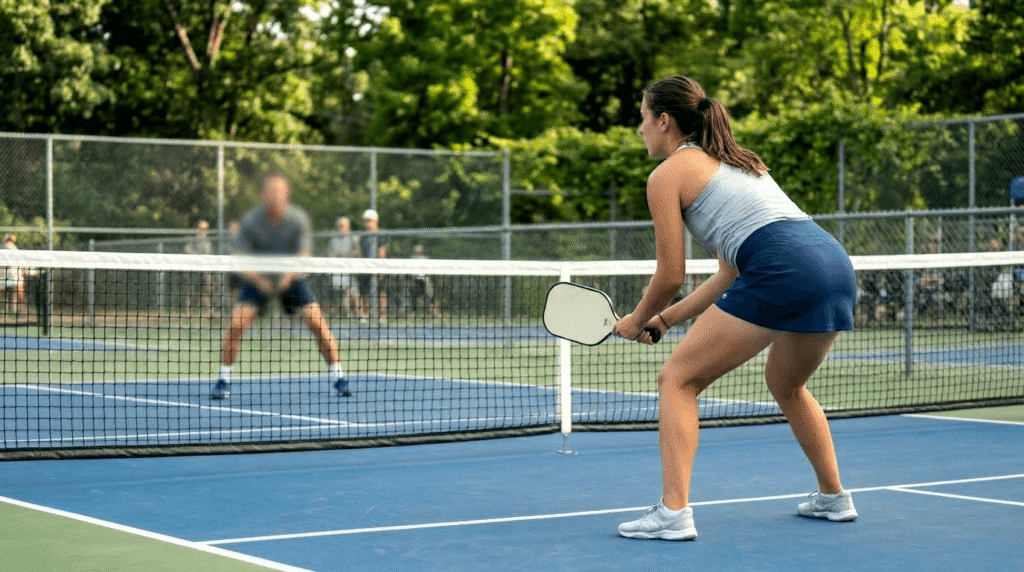
When you remove the unforced error as your primary point-winning mechanism you have to replace it with something. The soft-game-only player has nothing to replace it with. They keep waiting. The opponent keeps resetting. The rally goes twenty-five balls deep and then one player does something different. At 4.0 that player is usually not the one who has been waiting.
Patience is a virtue at every level. But patience without the ability to create is just waiting.
1.1. What Soft Game Only Looks Like Against a Complete Player
I want to be specific about this because the gap is not always obvious from the scoreline. The soft-game-only player can compete in rallies. They can take games. But watch the point construction and the pattern is clear. They survive the rally until the opponent decides to end it. They do not have a mechanism to end it themselves on their terms. At 4.0 that asymmetry compounds over a match.
The complete 4.0 pickleball player is not necessarily hitting harder or being more aggressive across the board. They are being selective. They know which balls to attack, which to keep soft, and which require a speed-up to prevent the opponent from getting comfortable. That selectivity is the thing the soft-game-only player is missing.
1.2. Soft Game Only vs Complete Player: How the Same Situations Play Out
The table below shows five common match situations and how a soft-game-only player responds compared to a complete 4.0 player. The difference is not about hitting harder. It is about having options.
Resets well, survives, keeps dinking.
Resets then counter-attacks next opportunity.
Dinks it back anyway out of habit.
Drives it with intent to a specific target.
Rushes to kitchen regardless of ball quality.
Reads the ball and stays back when it makes sense.
Waits for opponent error, no plan B.
Manufactured opening through placement variation.
Dinks indefinitely hoping for an error.
Varies pace and spin to create the opening.
The pattern is consistent across all five situations. The soft-game-only player has one response: keep it soft, wait, survive. The complete player has the same soft response available but also the option to do something different when the situation calls for it. Having the option changes how the opponent plays even on the points where the option is never used.
USA Pickleball’s official skill level definitions describe the 4.0 player as someone who can turn defensive shots into offensive ones and adjust their game plan according to the opponent’s position and weaknesses. A player whose entire strategy is to keep the ball soft meets only half of that definition.
2. What 4.0 Opponents Actually Do to the Soft Game
If you want to understand why the soft game stops being enough at 4.0 the clearest way to see it is to watch what a good 4.0 pickleball player does when they recognize a soft-game-only opponent. They do not try to out-dink them. That is the opponent’s strongest ground. They do something more specific and more damaging.
2.1. They Speed Up Early to Test the Reset
A 4.0 player who senses a soft-game-only opponent will test the reset early in the match, usually in the first two or three games. They fire a hard ball at the body or hip to see what the response is. If the reset is solid they note it and move on. If the reset is shaky they come back to that location repeatedly because they have found the chink in the armor. The soft-game-only player who cannot reset reliably under pace is immediately at a structural disadvantage.
2.2. They Apply Pressure Through Spin Variation
Pure pace is not the only weapon. A 4.0 player who can vary spin on dinks forces the soft-game-only opponent into uncomfortable contact positions. Heavy topspin that kicks up unexpectedly. Slice that stays low and skids through. Sidespin that moves away from the paddle face at contact. Against a player who has only practiced soft exchanges with relatively flat balls, spin variation is deeply disruptive and it does not require aggression. It just requires variation.
USA Pickleball’s official coaching resources cover spin mechanics and advanced dink technique in detail and are worth reading if you want to go deeper on the variation side of the kitchen game.
2.3. They Stay Back Intentionally When Rushing Forward Suits Them
Some 4.0 players will deliberately not rush to the kitchen against a soft-game-only opponent. They stay back in the transition zone and trade from there, putting the soft-game player in a position of having to play balls from an awkward depth rather than a kitchen battle they are comfortable with. This forces errors from players whose entire game is calibrated for kitchen exchanges.
A complete player does not just have better shots. They have more ways to make your best shots feel uncomfortable.
3. The Three Skills That Bridge the Gap
Getting from soft-game ceiling to complete 4.0 pickleball player does not mean rebuilding from scratch. It means adding three specific capabilities on top of the soft game foundation that is already there.
3.1. A Selective and Precise Speed Up
Not a speed up on every ball. A speed up on the right balls. The difference between a 3.5 speed up and a 4.0 speed up is not pace, it is selection. At 4.0 the speed up happens when the ball is at or above net height, the opponent is slightly out of position or leaning the wrong way, and the target is the body or hip rather than the open court. Those three conditions together make the speed up a high-percentage play. Any one of them missing and the soft response is almost always better.
The soft-game-only player either never speeds up or speeds up randomly without those conditions present. Building a selective speed up means drilling the decision as much as drilling the shot itself. You need to know which ball triggers it before you develop the mechanics of executing it.
3.2. Comfort in the Transition Zone
The soft-game-only player treats the transition zone as a space to pass through as quickly as possible. That works fine when the third shot drop is working. When it is not, or when the return is aggressive and deep, the player who can operate in the transition zone has a meaningful advantage. At 4.0 pickleball knowing when to stay back and drive from mid-court versus when to push forward is a specific skill, not just a decision that happens automatically.
Comfort in the transition zone requires two things. The ability to drive with enough consistency to make staying back a viable option and the judgment to know when the ball quality justifies it. Neither comes from kitchen drilling alone. They come from practicing specifically in the transition zone with a partner who is feeding realistic pace.
3.3. Spin Variation on Dinks
The soft-game-only player dinks flat or with mild topspin. That is predictable to any 4.0 opponent who has played enough matches. Adding slice, sidespin, and topspin variation to the dink game does not require a complete technique overhaul. It requires deliberate practice of shots that most recreational players never work on because the flat dink works well enough below 4.0.
At 4.0 a dink with heavy slice that stays low and moves away from the paddle face on contact is a genuinely difficult ball to attack cleanly. It is not more aggressive than a flat dink. It is more disruptive. Disruption without aggression is exactly what the complete 4.0 player has that the soft-game-only player does not.
4. Skill Profile Comparison: Soft Game Only vs Complete 4.0 Player
The ratings below reflect what I consistently observe across recreational matches at this level. Neither profile is good or bad in isolation. The point is where the gaps are and which ones matter most in close games.
High
High
High
High
Low
High
Low
Situational
Rarely used
Selective and precise
Moderate
High
Inconsistent
Consistent
5. What to Actually Practice
Most 4.0 pickleball players who are soft-game-only did not get there by accident. They built those skills through deliberate practice and open play repetition. The path forward is the same. Deliberate practice of the specific gaps. Not general improvement. Specific gap work.
5.1. The Constraint Dink Drill
Play a dink rally with a partner but add one rule. Every fifth ball must have a different spin than the previous four. Topspin, slice, flat, sidespin, flat again, then repeat with a different sequence. This forces you to practice spin variation in a live exchange context rather than in isolation. After four weeks of this drill in every session your dink variation will be noticeably broader and your feel for different spin types on contact will be significantly sharper.
5.2. Speed Up Triggers Only Drill
Set up a dink rally with a partner and agree on one rule. You can only speed up when the ball is at or above net height and your partner’s paddle is below their waist. Every other ball stays soft regardless of how much you want to attack it. This teaches selectivity first and mechanics second, which is the right order. A speed up triggered by the right conditions with average mechanics beats a perfect speed up triggered on the wrong ball every time.
5.3. Transition Zone Live Points
Play points where one player starts in the transition zone and the other starts at the kitchen. The transition zone player must drive at least two balls before they can advance. This forces the deliberate use of transition zone driving under game pressure rather than just as a drill pattern. After a month of this in regular sessions the discomfort of staying back drops significantly and the judgment about when to advance versus when to stay improves.
6. The Mental Shift Required
Beyond the physical skills there is a mental shift that has to happen for a soft-game-only player to break through the 4.0 pickleball ceiling. It is a shift in how you think about your role in a rally.
The soft-game mindset is reactive. Keep the ball in play, respond to what the opponent gives you, wait for the opportunity. That mindset is not wrong but it is incomplete. The complete player mindset is both reactive and constructive. Keep the ball in play when that is the right call and construct the opening when the situation offers it.
The shift does not mean becoming aggressive. It means becoming intentional. Every ball you hit at 4.0 should have a reason behind it that goes beyond keeping the rally going. Sometimes that reason is to reset and neutralize. Sometimes it is to apply spin variation and disrupt. Sometimes it is to attack. But the reason should be present, not random.
The soft game wins you the rally. The complete game wins you the point.
I have watched players make this shift over the course of a season and the change is visible before the results show up in the scoreline. They start looking different between shots. More deliberate, less passive. Like they are thinking about what they want to happen next rather than just responding to what just happened. That quality of intention is exactly what separates the players who break through the soft game ceiling from the ones who hit it repeatedly and wonder why their game has stopped improving.