
Look, if you have been playing for any decent stretch of time and your third shot drop pickleball situation is still all over the place, you are probably blaming the wrong things. I did it for months. Tested different paddles, changed my grip tape, watched way too many YouTube videos where some guy explains it perfectly in a controlled gym setting with a ball machine feeding him perfect balls. None of it fixed anything. The real problems were in places I was not looking, and once I actually saw them, most of it made total sense. This is just me writing down what I figured out the hard way.
Topics We’re Covering
1. The Shot That Humbles Everyone
Three years in now. Not a beginner anymore but definitely not someone who has it all figured out either. And the third shot drop has probably cost me more points than every other mistake combined. I wish I was exaggerating.
The frustrating thing is how easy it looks when someone good does it. They receive a hard return, take one step back, and just kind of guide the ball up over the net and it lands soft in the kitchen like they planned it all along. You think okay, that looks totally doable. Then it is your turn and the ball comes screaming at your backhand and suddenly your hands forget everything they have ever known.
You either dump it in the net or send up this awful floater that the opponents do not even have to move for. They just stand there at the kitchen line and put it away. Same result, different version of the mistake. And then you do it again on the next point.
I genuinely spent about six months thinking my paddle was the issue. Borrowed one from a guy in our Tuesday group. Bought a new one with a softer core. Spent way too long on Reddit threads comparing face textures. My brain kept telling me that this shot requires control and I needed a control paddle and maybe this was fixable with better equipment.
It was not. Someone finally watched me play and told me what was actually happening and it had nothing to do with my gear. That was the start of actually getting better at the third shot drop in pickleball. This is what I learned.
If you want the official breakdown of the third shot drop mechanics, USA Pickleball has a solid overview of the third shot drop basics worth reading alongside this. [Third Shot Drop Basics]
2. What Most Players Are Actually Doing Wrong
Let me just describe what I was doing because honestly it is probably close to what you are doing too.
Return of serve comes in deep. I shuffle back, get sort of set, and then I try to do this soft little push shot over the net. Sometimes I take a bigger swing and try to ease off at the end. Sometimes I stab at it. It depends on how panicked I am in the moment. The results are all over the place.
2.1. Making Contact Too Close to Your Body
The biggest thing wrong was where I was making contact. Way too close to my body. When the ball gets tight on you, you cannot really feel the paddle face, you lose whatever leverage you had, and you end up kind of muscling the ball rather than actually guiding it. Soft shots do not work when you are muscling them. You need some room in front of you to actually swing with a relaxed arm.
2.2. Tensing Up at the Wrong Moment
The other thing, and this one is a bit weird to explain, is that I was trying to kill the pace of the ball right at the moment I hit it. So the ball comes in fast, I feel all that speed, and I tense up at contact thinking that will slow things down. But it does the opposite. Tight grip, stiff forearm, ball pops off weird. You actually need to stay loose through the whole swing and let the path of the swing handle the pace, not your grip.
2.3. Reading the Ball Too Late
Third thing is just not watching the ball early enough. I was reacting late, which meant my feet were late, which meant my prep was rushed, which meant the swing was rushed. A rushed finesse shot almost never goes well. By the time I was getting ready to hit, the ball was basically already on me.
None of this is a paddle problem. It is all stuff that gets baked in over time from playing without really thinking about what you are doing. Every player I know who cleaned up their third shot drop pickleball technique had to unlearn at least two of these things. The annoying part is you have to kind of do it deliberately, it does not fix itself just from playing more.
3. The Footwork Problem That Hurts Your Third Shot Drop
Footwork comes up a lot in pickleball but usually people are talking about getting to the kitchen or chasing down a ball wide. What almost nobody talks about is what your feet are doing specifically when you hit the third shot drop, and it matters more than most players realize.
3.1. Why Static Feet Kill the Shot
Picture the typical recreational player receiving a deep return. They take a step or two back, they stop, they plant, and then they swing. The problem is that stopping and planting usually means the weight is either going backwards or just sitting flat. And when your weight is going backwards, or even just neutral, the shot has no direction. You are relying completely on your arm to produce a controlled soft shot and that is just not reliable.
You want to be stepping forward into the contact. Even a small step. Think about throwing a ball underhand to someone, like a gentle toss. You step into it naturally. Weight comes forward, arm follows, ball goes where you want. Nobody throws flat-footed and just flicks their wrist. Same thing applies here. That small step forward gives the shot direction and shape that your arm by itself really struggles to create consistently.
3.2. Getting Into Position Before the Ball Arrives
There is also just the positioning side of it. The drop works best when the ball is a bit out in front of you and slightly to your hitting side. When the ball jams you, or you are slightly off to one side in an awkward way, everything tightens up. Most recreational players never actually practice getting their feet into the right spot. They just react to wherever the ball goes and then deal with whatever position they end up in.
There was a guy I played with maybe a year ago who had been competing for a long time. His drops were just consistently good, not perfect, but good, like every single time. I watched him for a while and what I noticed was that he barely seemed rushed. I asked him about it afterward and he said something I still think about. He said by the time I swing, the shot is already done. I just have to show up in the right place. He meant the footwork happened early enough that the swing itself was almost relaxed. That idea changed how I practice.
4. Timing and Contact Point, the Real Stuff
Okay this part gets a little specific but I will try to keep it out of coaching manual territory.
4.1. Where to Make Contact
Contact point is huge. The drop works best when you are hitting the ball out in front of your body, somewhere around waist height or a bit lower, on its way down. When contact happens late, like beside your hip or behind it, you lose any real feel for where the paddle face is pointing and the whole thing becomes a guess.
Taking the ball early, before it drops all the way to its lowest point, sounds counterintuitive because you might think a lower ball automatically means a lower shot. But waiting for the ball to fall completely usually means you rush the swing to catch it, and that rush is what kills the drop. Taking it a bit earlier, maybe knee height or so on its way down, gives you more time and a cleaner contact position.
4.2. The Low to High Swing Path
The swing itself is low to high. Not a flat push, not a scoop. Just a gentle upward path that carries the ball over the net. When the shot goes into the net it is almost always because the swing was flat or the paddle face was pointing down slightly at contact. When it floats it is usually a too-aggressive scoop or someone swinging harder than they needed to.
One thing that genuinely helped me was thinking about where the paddle ends up after the swing rather than focusing on the moment of contact.
When I fixated on contact I would tighten up right at the hit. When I thought about following through toward my target spot in the kitchen, the whole motion loosened up and became more fluid. Sounds small but honestly it was one of the bigger third shot drop pickleball tips that actually stuck for me.
5. The Mindset Spiral That Makes It Worse
This is the part that tends to get skipped in instructional stuff because it is uncomfortable to talk about. But honestly, for a lot of rec players, the mental side of this shot is where things really fall apart.
The third shot drop has weight to it. You know you are supposed to hit it in that situation. Your partner knows. You know the opponents are expecting it. So when you step up to hit it there is this low level pressure that does not exist on most other shots. And what that pressure does, at least what it did to me, is make me think too much while I was swinging.
I would be in the middle of the shot having a whole internal conversation. Stay loose, get under it, do not swing too hard, watch the contact point. By the time the ball actually arrived my arm was basically frozen from overthinking. The shot would fall apart and then I would do the same thing on the next point.
I went through this stretch where I missed the drop three or four times in a row and started staring at my paddle between points. Just staring at it. My partner Dave finally got fed up and said something like, the paddle is not making the choices here, you are. Which was not gentle but was completely correct.
The drop needs trust. You have to decide on the shot, commit to it, and then let your body do what it has practiced. When you start narrating the swing in your head while you are doing it, you override that process and you almost always make it worse. The players I have seen hit consistent drops are not people who never miss. They are people who do not seem rattled by the ones that miss. They just move on.
I also stopped doing the visible frustration thing on court. The paddle staring, the muttering, the shaking my head. It accomplished absolutely nothing except telling the other side that I was bothered.
Once I cut that out and just turned and reset after a bad drop, my whole third shot started holding up better under pressure. That connection between staying calm outwardly and actually playing calmer is real.
6. The Paddle Myth, Let’s Just Settle This
I already mentioned I bought a new paddle chasing this shot. Spent two hundred and fifty dollars because the guy at the pro shop said it had the best control on the market. I want to be honest about what happened. Nothing changed. Not really. Maybe the first week felt slightly different because it was new and I was paying more attention. Then I went back to hitting the exact same third shot drops in pickleball in the exact same situations with the exact same results.
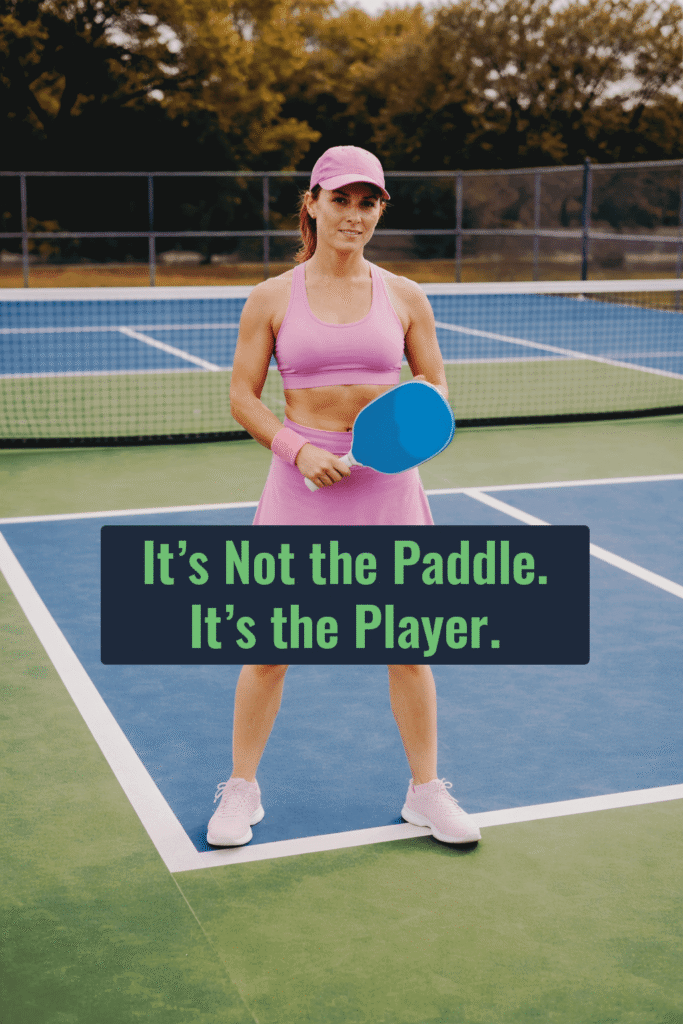
Here is the thing. A control paddle, softer core, rougher face, all of that stuff sounds exactly like what a finesse shot needs. And look, if you are playing with a cracked paddle or something truly cheap and beat up, sure, upgrade. That makes sense. But if you already have a reasonable paddle and you are thinking about dropping serious money on something premium because your drops are inconsistent, I would really think twice about that.
The pattern I see over and over in recreational play is someone hits a plateau, gets frustrated, buys new gear. It feels productive. You did something about the problem. Then you go back out and hit the same shots because the paddle is not what was causing them. Paddle gets blamed, paddle gets swapped out, plateau stays exactly where it was.
6.1. What Actually Moves the Needle
What actually moves the needle is practice with real feedback. Not just hitting a hundred third shot drops alone with no idea if they are landing where they should. Having someone watch, tell you what they see, give you real information. And practicing the shot in conditions that are closer to a real game, not just soft feeds from a basket but actual hard returns that you have to redirect. Most people never do that second part and then wonder why the shot works in drills and falls apart in games.
Equipment is like two percent of this. Maybe. The rest is mechanics, feel, and what happens in your head when the pressure is real.
7. How to Actually Practice This Shot
So if it is not the paddle and it comes down to mechanics and footwork and mindset, what does useful practice actually look like. Here is what helped me.
7.1. Start Slow Before You Add Pressure
First, slow practice away from any game context. Just go out with someone and hit drops, no score, no points, no stakes. Start from roughly where a return of serve would land you on the baseline and just work on the motion. But do not try to fix five things at once. Pick one. Spend a week just noticing contact point. Then a week on footwork. Then swing path. One thing at a time sticks a lot better than trying to overhaul the whole shot in one session.
Have the other person feed from near the kitchen and give you real feedback. High, short, long, into the net. You do not want yes or no, you want specific. That kind of immediate information is worth way more than trying to judge your own shots while you are still in the motion.
7.2. Why Live Feed Practice Beats Soft Drills
Once that starts to feel okay, switch to a live feed. Have someone actually drive the ball at you like a real return of serve would come in. Hard, deep, with some pace. That is a completely different challenge from a soft toss and it is way closer to what you will face in a real game. Most rec players only practice drops off easy feeds and then are surprised when it breaks down against a hard return. The feel is just different when the ball has pace on it.
7.3. Shadow Swings and Pressure Reps
Shadow swings. I know this sounds weird but it works. Stand at the baseline with no ball and just go through the drop motion over and over. Focus on your feet, feel the weight shift, notice where the paddle goes on the follow through. Without a ball to track you can pay full attention to just the movement. Real athletes in other sports do this constantly. Most pickleball players have never tried it.
And then pressure practice. Play points where you do not care about winning the rally, your only job is to execute the drop. Have the other side attack it aggressively on purpose. The goal is to get used to hitting the shot knowing it will be tested. Over enough reps, that pressure starts to feel normal instead of stressful.
8. What Finally Clicked for Me
I want to finish this honestly rather than with some tidy little wrap up where everything got solved and I now hit perfect drops every time. That is not what happened.
The shot got better slowly. Over many months. There were still games where it fell apart completely. What shifted was not some single moment where I found the right technique. What shifted was I stopped looking for a shortcut and started actually paying attention to what was happening on the good reps versus the bad ones.
The good third shot drops all had a few things in common. Ball was out in front, arm was loose, I was stepping forward. The bad ones were almost always rushed, cramped, or I was off balance in some way. Once I could actually feel that difference mid-practice, I had something to work toward. Before that I was just swinging and reacting.
Dave, who has seen me at my worst with this shot, said something once that I still think about. He said the drop is not actually that hard of a shot. The hard part is getting out of your own head long enough for your hands to do what they already know how to do. I have found that to be pretty accurate.
There is something kind of freeing about accepting the paddle is not the problem. Because it means the answer is not something you need to buy or find somewhere else. It is already there. You just have to be willing to do the actual work of building a real habit instead of looking for the easier fix.
Next time you are out there and the third shot drop in pickleball keeps going wrong, before you look at your paddle, check where you are making contact. Check if your weight was moving forward. Check if you tensed up at the last second. Those are the things that actually determine where the ball goes.
The paddle was fine the whole time. Yours probably is too.