
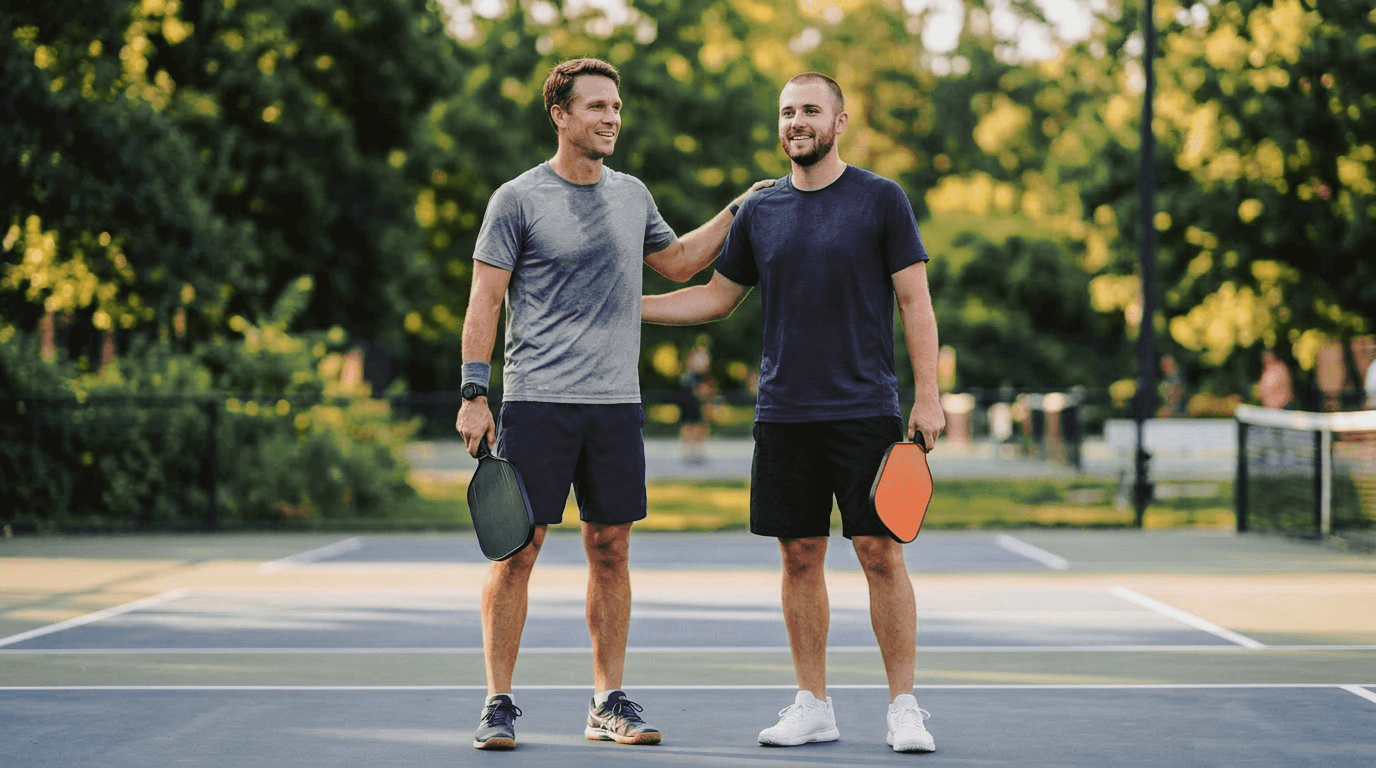
I am going to be straight about something. When I first started playing pickleball I was not a great partner. Not because my game was bad, it was fine for the level I was at. But I was the kind of player who went quiet after a bad shot, got visibly tense when we were losing, and occasionally gave feedback nobody asked for. I thought I was being focused and competitive. What I was actually being was difficult to play with. It took someone saying it directly to me before I understood that being a good pickleball doubles partner is a skill, and like every skill it has specific components you can actually work on.
This is not a soft topic. The pickleball doubles partner dynamic in doubles is a genuine performance factor. Teams that function well together win more than teams of equal skill that do not. That is not an opinion. Watch any competitive open play session and you will see it. The team where both players are locked in together, covering each other, communicating, staying even emotionally, consistently outperforms the team where one or both players are in their own heads.
So this article is about the practical side of that. What does being a good doubles partner actually require, not in a vague feel-good sense but in specific behaviors and habits that you can either do or not do. Some of it is mindset. Some of it is communication. All of it is trainable.
Topics We’re Covering
1. Why Partner Quality Matters More Than Most Players Think
Most players think about improving their game in individual terms. Better third shot drop, more consistent reset, tighter dinks. All valid. But in doubles, which is how most recreational pickleball is played, your game does not exist in isolation. It exists in a system with another person and that system either functions well or it does not.
I have played with pickleball doubles partners who made me play better than I actually was. Not because they were covering for my weaknesses, though sometimes they were, but because the dynamic between us was clean. Communication was simple, there was no tension after errors, and I always knew roughly where they were and what they were thinking. That ease frees up mental bandwidth that you would otherwise spend managing the relationship. And that freed up bandwidth goes into actually playing better.
I have also played with partners who dragged my game down despite being technically better players than me. The tension after my errors, the absence of communication, the unpredictability of their positioning and decisions. All of it created noise that I was processing during rallies instead of just playing.
Being a genuinely good pickleball doubles partner is not just a nicety. It is a competitive advantage. The teams that are relaxed and coordinated are harder to beat than the teams that are tense and fragmented, even when the raw skill level is similar.
2. What Bad Partners Actually Do, The Specific Habits
Before talking about what good pickleball doubles partners do, it is worth being specific about the bad habits because most players who have them do not realize it. I did not.
2.1. Visible Negative Reactions After Errors
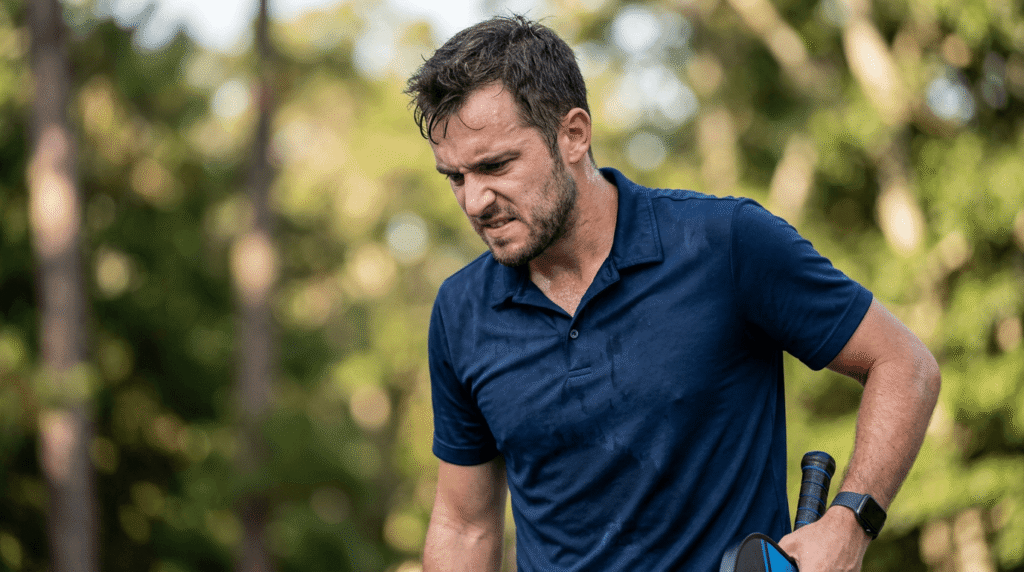
The paddle tap on the leg. The audible exhale. The eyes going to the ceiling. The three-second stare at the spot where the ball landed. These reactions feel private but they are not. Your partner sees every single one of them and it affects how they play the next point. A partner who reacts negatively to errors, even their own, creates a low-level anxiety in the team that accumulates over the course of a match.
In tennis you play alone so your emotional reactions affect only you. In doubles they affect two people. That is a real difference and most players never fully account for it.
2.2. Unsolicited Feedback Mid-Match
Unless your partner has specifically asked for coaching during play, feedback mid-match almost always lands wrong. Even when it is accurate and well-intentioned. Your partner is already processing what happened. Adding your analysis on top of that processing creates more noise, not less. And if the feedback has any critical edge to it, even subtle, it introduces a dynamic that is very hard to come back from mid-match.
There is a time for feedback and it is not between points during a competitive game. If your partner asks, answer briefly and move on. If they do not ask, keep it until after the match or not at all.
2.3. Disappearing After a Bad Stretch
Some players go quiet and internal when things are going badly. No communication, minimal eye contact, body language that says I am somewhere else right now. This might feel like focus but from the partner’s perspective it reads as withdrawal and it is demoralizing. The moments when a partner most needs connection are the moments right after things go wrong, not when everything is working.
2.4. Taking Over When Nervous
The opposite problem. When the score is tight some players start poaching more, calling balls that are clearly their partner’s, taking shots from positions that should be their partner’s responsibility. This comes from anxiety and the belief that controlling more of the game will produce better results. It usually does the opposite because it puts your partner in a passive uncertain role and disrupts the positioning system you have been using all match.
3. Emotional Steadiness, The Foundation of Everything
If there is one thing that distinguishes the pickleball doubles partners people want to play with from the ones they avoid it is emotional steadiness. Not positivity. Not enthusiasm. Steadiness. The ability to look and behave more or less the same whether you just hit a winner or dumped three shots in a row into the net.
3.1. Why Steadiness Is Not the Same as Not Caring
I want to be clear about this because it comes up. Emotional steadiness does not mean you are detached from the result or that losing does not bother you. It means you have developed enough control over your visible reactions that your partner is not reading your emotional state off your body language every few points. You can care deeply about winning and still look calm between points. Those are not contradictory things.
The practical value of this is that your partner can focus on playing rather than on managing how you are feeling. That is an enormous gift in a competitive situation. The best pickleball doubles partner mindset is one where your partner barely has to think about you because you are consistently neutral and reliable between points.
3.2. How to Actually Build It
This is where Mason the practical person comes in. Steadiness is not a personality trait you either have or do not have. It is a behavioral habit you build through repetition.
Start with one specific thing. After every error, your own or your partner’s, your visible reaction is neutral and your next action is immediate readiness. Paddle up, feet set, eyes forward. That is it. No processing time in view of your partner. Whatever you feel about the error, the external behavior is reset and ready. Do this consistently for an entire session and notice how the dynamic on court changes.
It feels unnatural at first because you are suppressing responses that feel instinctive. But after enough repetition it becomes the instinct. The emotional processing still happens, it just happens internally and quickly rather than visibly and slowly.
4. Communication That Actually Helps
Good doubles communication is not about talking a lot. It is about saying the right things at the right moments so both players have the information they need without either one having to think too hard about it. If you want a broader look at how doubles strategy and partner coordination fit together, USA Pickleball’s doubles strategy guide covers the fundamentals well and is worth reading alongside this.
4.1. The Calls That Matter
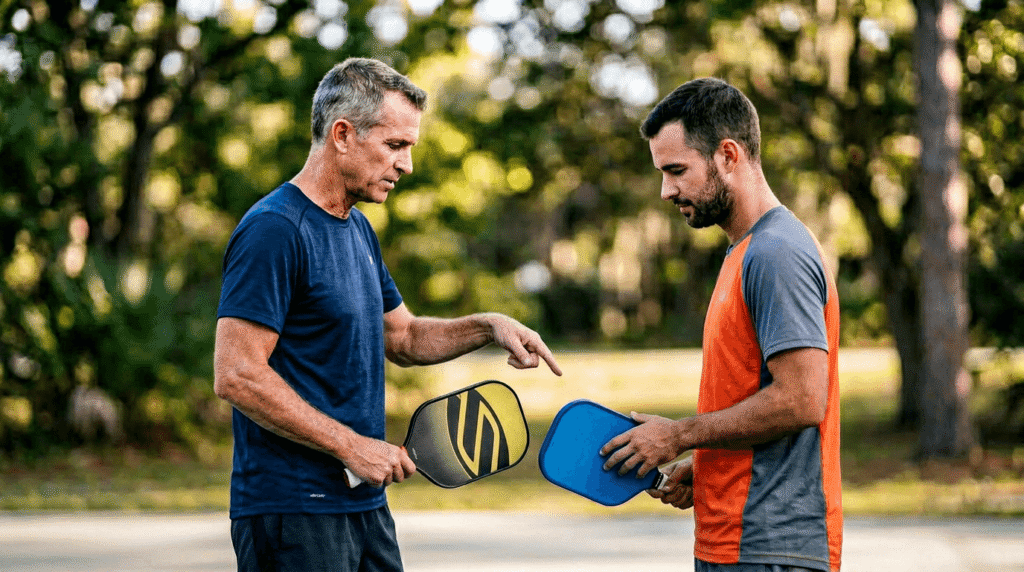
Mine and yours on balls between you. In or out on close line calls. Switch when you cross positions. These three cover the vast majority of communication situations in a doubles rally. They are short, unambiguous, and give your partner something concrete to act on. Short specific calls beat silence every time and they also beat long complicated calls that arrive too late to be useful.
Before the point starts, a quick word about strategy is fine. We are staying back this point, lets keep it soft, I am going to poach middle if I get the chance. One sentence, clear intention, then play. That kind of pre-point communication builds a shared picture of what both players are trying to do.
4.2. Encouragement That Does Not Feel Hollow
There is a version of encouragement that good pickleball doubles partners deliver and a version that lands flat. The flat version is generic. Good shot, nice one, great job. These are fine but they are noise after a while. The version that lands better is specific. Good call staying back on that one, that reset was exactly right, nice patience on that dink rally. Specific acknowledgment tells your partner you are watching and you understand what they are doing well. That is more useful than a generic positive response.
And after errors, a simple that is fine or we got the next one is enough. You do not need to diagnose what went wrong or offer reassurance at length. Brief and genuine is better than thorough and performative.
4.3. When to Say Nothing
Sometimes the best communication is silence. When your partner has just made a bad error and is already aware of it, anything you say draws more attention to it. Let it go. Move immediately into ready position and let the silence communicate that you are already on the next point. That kind of disciplined silence is actually harder than talking and more valuable.
5. Covering for Your Partner Without Making It Weird
Every pickleball doubles partner has gaps. Weaker backhand, slower transition, less reliable overhead, whatever it is. Good partners figure these things out quickly and adjust positioning and shot selection to compensate without drawing attention to it or making the partner feel managed.
5.1. Figure Out the Gap Early and Quietly
In the first game with a new pickleball doubles partner you are gathering information. How do they move? Where do they struggle? What is their default shot under pressure? You are not doing this to judge them. You are doing it so you can position yourself to cover what they cannot cover and direct the game away from their weaknesses where possible. This is just good doubles strategy and the best partners do it automatically.
You do not need to say anything about it. You just adjust. If your partner struggles on the backhand side, position yourself slightly toward that side so you can intercept more balls heading there. If they are slow to transition forward, cover the kitchen a bit more aggressively on points where they are behind you. Small quiet adjustments that improve the team without making your partner feel like a liability.
5.2. Do Not Overcompensate
There is a version of covering for your partner that goes too far and actually makes things worse. Poaching every ball, calling everything, taking shots that are clearly in your partner’s space. This communicates, even if unintentionally, that you do not trust your partner to handle their own responsibilities. It puts them in a passive role and usually produces worse results than if you had just let them play their side.
Cover the genuine gaps. Let your partner play the rest. That balance is the thing.
6. How to Handle Losing Without Taking the Team Down With You
Losing is part of the game. Every team loses sometimes. What separates good pickleball doubles partners from difficult ones is not whether they lose but how they handle it when they do.
6.1. Do Not Assign Blame, Even in Your Head
When a team loses a close match there is almost always a mental accounting that happens afterward. We lost because of that missed overhead. We lost because of those three errors at 9-9. That accounting is natural and sometimes useful for learning. What is not useful is when it attaches to a specific person, especially your partner.
Even if one player did make more errors in a critical stretch, doubles losses belong to both players. Your positioning affected their shots. Your shot selection created situations they had to deal with. The interconnection goes both directions and the players who understand that are the ones who can review a loss productively rather than just finding somewhere to put the blame.
6.2. Reset Quickly Between Games
The best pickleball doubles partners I have played with have a short emotional half-life after a bad game. They process it fast, they identify one or two things to do differently, and then they are ready for the next one. The partners I have found difficult carry the bad game into the next one, visibly. That carry-over affects everything.
A practical thing that helps: between games, say one thing that worked and one thing to try differently. Keep it brief, keep it forward-looking. That short ritual gives the bad game somewhere to go without letting it take over the next one.
7. Adjusting Your Game for Your Partner, Not Just Yourself
This one requires a bit of ego management and I will be honest that it took me longer to get here than it should have. The adjustments that make you a better individual player are not always the adjustments that make you a better pickleball doubles partner. Sometimes the best thing you can do for your team is play a slightly different game than you would choose for yourself.
7.1. Match Your Partner’s Pace When They Are Struggling
When your partner is having a bad stretch, the instinct is to take over and carry more of the load. Sometimes that is right. But sometimes the better move is to slow things down, keep the ball soft, and reduce the number of decisions your partner has to make under pressure. A simpler slower game gives a struggling partner time to reset mentally in a way that a fast aggressive game does not.
This requires reading your partner as well as you read your opponents. Are they getting faster and more decisive as the match goes on or are they tightening up? The answer should influence how you play.
7.2. Play to Your Partner’s Strengths in Key Moments
If your partner has a strong overhead and you are in a situation where you can set one up, set it up. If their forehand is more reliable than their backhand and you can direct traffic in a way that favors it, do that. This is just intelligent doubles play but it requires you to be thinking about your partner’s game as actively as you think about your own.
The best pickleball doubles partner relationships I have seen work like this. Both players have a picture of what the other does well and they actively create situations that play to those strengths. It is collaborative in a very practical sense and it produces better results than two players each independently trying to play their best individual game.
8. The Reputation You Build and Why It Matters
Pickleball communities are small. The people at your local courts, your regular open play group, the competitive sessions you attend, they all see how you behave as a pickleball doubles partner over time. That accumulated observation builds a reputation and that reputation has real practical consequences.
8.1. People Choose Partners Based on More Than Skill
When a better player is looking for a partner for a competitive session or a tournament, they are not only evaluating your backhand. They are thinking about what it is like to play with you under pressure. Do you stay steady when things go wrong? Do you communicate or go silent? Do you make your partner feel like they are playing with someone or playing alongside someone? Those questions matter and experienced players have good answers to them after watching you a few times.
I have seen technically limited players get picked consistently over stronger players because they are known to be good partners. Calm, communicative, reliable under pressure. And I have seen strong players passed over because their reputation for being difficult is established enough that people would rather take the slightly weaker but easier option. Being a good pickleball doubles partner is a genuine competitive asset, not just a social nicety.
8.2. The Standard You Hold Yourself To
The simplest frame I have found for thinking about all of this is one question. After playing with me today, does my partner want to play with me again? Not are they impressed by my game. Not did I play well. Does the experience of being on my team make them want to repeat it.
If the answer is consistently yes, you are building something. A reputation, a network of good pickleball doubles partners, the kind of team dynamics that produce actual improvement over time. If the answer is sometimes or probably not, you have something specific to work on.
The pickleball doubles partner mindset is not complicated. Stay steady. Communicate simply. Cover your partner without taking over. Handle losing without drama. Adjust your game for the team not just for yourself. Do those things consistently and you become the partner everyone wants to play with. It is a skill. It is learnable. And it pays off faster than most technical improvements you could make to your game.