
I have played with a lot of people over the last few years and one thing I notice pretty quickly in a new partner is whether they are watching the ball or watching the game. Those are not the same thing. Watching the ball is the obvious thing, the thing everyone does automatically. Watching the game means you are also tracking where your opponents are standing, what gaps are open, what your partner is doing, and what the court is telling you about what should happen next. That second layer is what people mean when they talk about court awareness in pickleball. And almost nobody teaches it deliberately.
Most instruction time goes to technique. Serve mechanics, dink consistency, third shot drop, reset position. All of that matters. But I have seen players with genuinely good technique lose to players with average strokes because the second group understood the court and the first group did not. They knew where to be, when to attack, when to wait, and where the gaps were before the ball even got there. That knowledge is not accidental. It is a skill, and like every skill it can be built.
This article is about how to start building it. Not in a complicated theoretical way. Just practically, from someone who has spent a lot of time paying attention to things on court that most players walk right past.
Topics We’re Covering
1. What Court Awareness Actually Means
Before anything else let me just explain what I mean when I say pickleball court awareness because people use the phrase loosely.
It is not about having fast reflexes. It is not about being athletic or having a great feel for the ball. It is specifically about knowing what is happening on the court beyond just the ball you are about to hit.
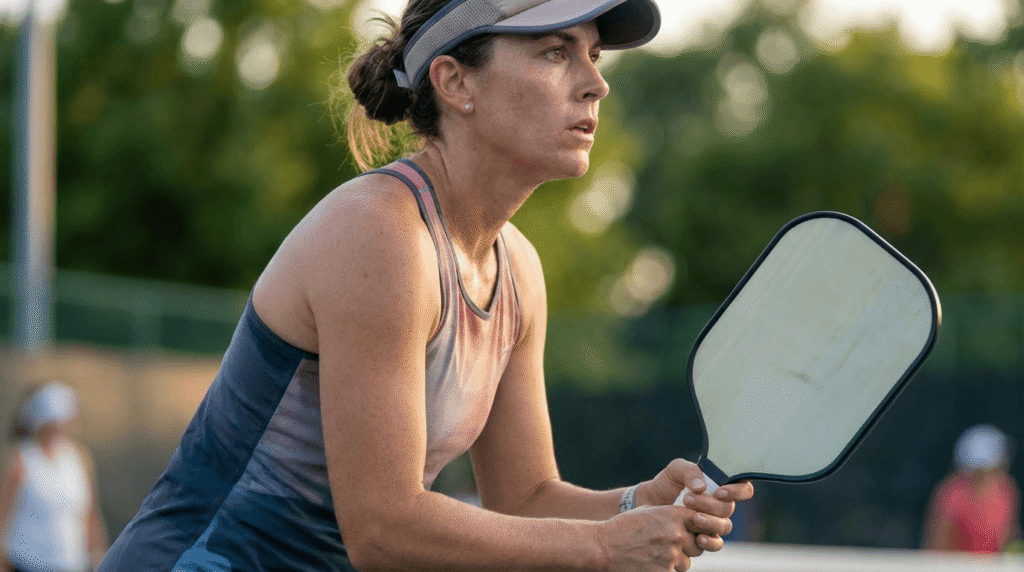
Where are both opponents standing right now? Is there a gap down the line? Has your partner drifted too far left? Is the crosscourt opponent leaning toward the middle? Is this ball going to let you attack or does it need to be kept soft? All of that information is available on every single point. Most players are not collecting any of it because they are locked onto the ball.
Court awareness is the habit of collecting that information fast enough to use it. It is peripheral vision combined with pattern recognition combined with knowing what different situations call for. It sounds complicated but it mostly comes down to training yourself to look at more things during the moments you already have.
The good news is you do not need to be smarter or faster to develop it. You just need to know what to look for and practice looking for it deliberately.
2. Reading the Court Before the Ball Arrives
This is one of the things that separates players who feel like they are always scrambling from players who look calm even in fast rallies. The calm ones have already made their decision before the ball reaches them. The scramblers are still deciding when it gets there.
That difference comes down to one habit: scanning the court in the split second while the ball is traveling toward you.
2.1. The Window Between Shots
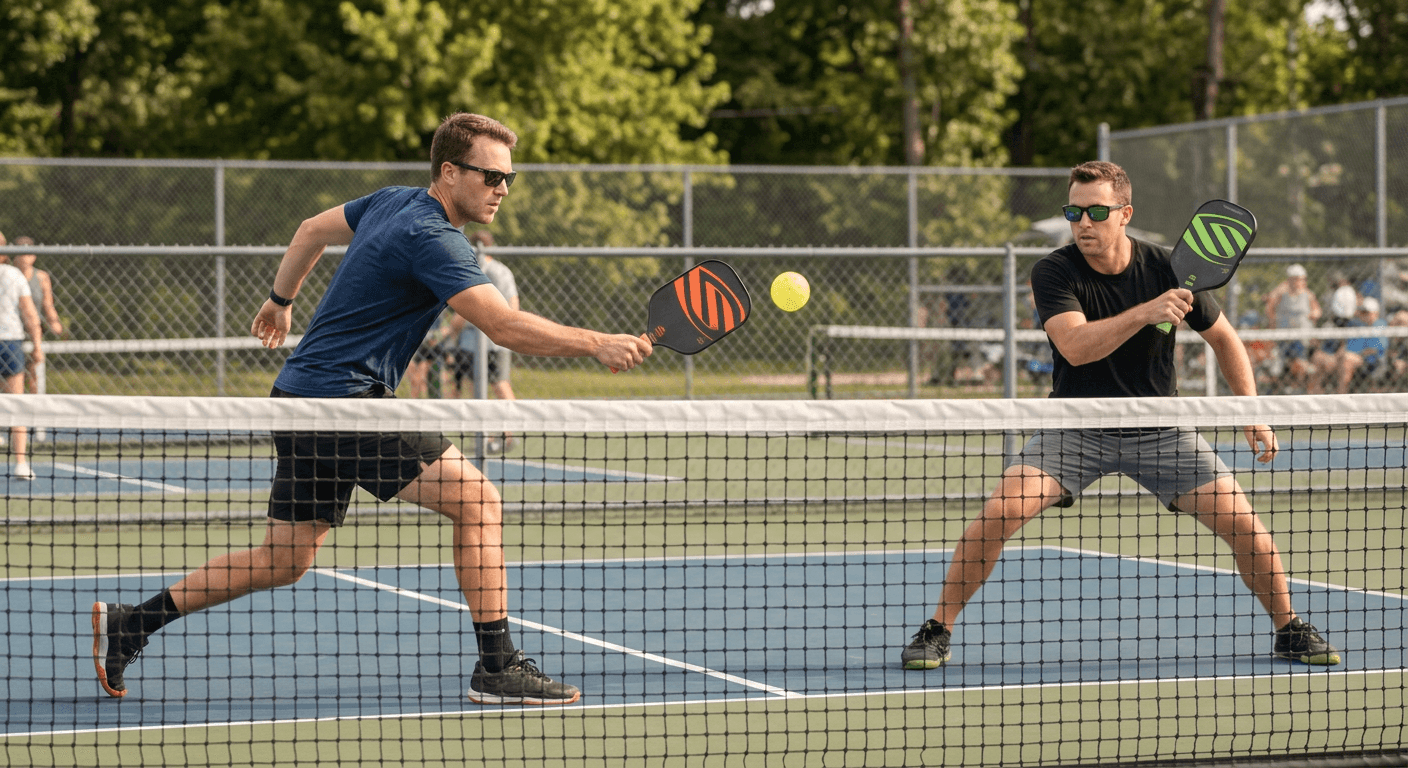
When the ball leaves your opponent’s paddle and is traveling to you, there is a small window where you can lift your eyes off the ball briefly and scan the court. Not for long. A fraction of a second. But in that fraction you can see where both opponents are standing, whether there is a gap, whether your partner has moved. That information shapes what you do before the ball even arrives at you.
Most recreational players spend that entire window staring at the ball. Which makes sense, it is the ball, it is coming at you. But experienced players have learned to trust their peripheral vision for ball tracking long enough to glance at the rest of the court. That glance is where the decision gets made.
I started practicing this deliberately about a year ago and it felt awkward at first. I missed a few balls because I looked away at the wrong moment. But after a few weeks it became automatic and now I cannot imagine not doing it. The amount of information available in that half second is enormous if you train yourself to use it.
2.2. Pre-Loading the Decision
What you are trying to do with that scan is pre-load your decision before contact. You have already decided where the ball is going before you hit it. That pre-loading means your execution is cleaner because you are not making choices while you are swinging. The choice was made a half second earlier. The swing is just delivery.
Players who make this shift describe it as the game slowing down. It does not actually slow down. They just have more time because they stopped wasting it making decisions at contact.
3. Seeing More Than the Ball
Good court awareness pickleball means your attention is split across several things at once, not just locked on the ball. Here is what the better players are actually tracking.
3.1. Opponent Position
Are they at the kitchen line or have they drifted back? Is one of them cheating toward the middle? Is the near opponent leaning to their backhand side? All of this tells you where to put the ball. A player leaning left has a gap to their right. A player who has drifted back from the kitchen is giving you the kitchen. A player cheating toward the middle is giving you the line.
None of this is complicated. You just have to actually look. Most players do not look because they are too focused on the ball. The information is sitting there on every point and most people walk right past it.
3.2. Open Spaces
After you spot where the opponents are, the open space becomes obvious. The gap is wherever they are not. This sounds almost too simple but it genuinely is that direct. Two players cannot cover the whole court. If both opponents are near the middle, the lines are open. If one opponent has moved wide, the middle is open. You are looking for the space their positioning is giving you.
A lot of recreational players aim based on habit, usually crosscourt because that is the natural stroke direction, or down the middle because it feels safe. Players with court awareness aim based on where the gap actually is, which changes on every ball.
3.3. Partner Movement
In doubles this is massive and almost completely ignored at the recreational level. Where is your partner right now? Have they drifted wide? Are they too close to the kitchen line? Are they covering the right side of the court for where you are about to hit?
Your shot selection in doubles should be influenced by your partner’s position as much as your opponents’ position. If your partner has moved left, you need to cover right on the next ball. If your partner is at the kitchen and you are still transitioning, you need a shot that buys you time to get up there. Doubles is a coordinated system not two individual games happening side by side. The players who understand that look completely different from those who do not.
3.4.Court Geometry
The court is not just a space you hit into. It has angles and dimensions that reward certain shots from certain positions. Hitting from wide opens the crosscourt angle. Hitting from the middle closes it. A ball deep in the court gives your opponents more time. A ball short forces them to reach. None of this requires geometry knowledge, just awareness of what the court shape is doing on each ball.
4. Why Most Players Never Develop This Skill
It is not that people are unaware that court awareness exists. Most players know the concept. They just never actually develop it and there are a few specific reasons for that.
4.1. Beginners Focus Only on Making Contact
When you are new to pickleball, getting the ball over the net in roughly the right direction is already demanding enough. There is no spare attention for anything else. Every bit of focus goes to watching the ball, timing the swing, not mishitting. That is completely appropriate for beginners. The problem is a lot of players stay in that mode long past when they should have graduated from it.
Once you can hit the ball consistently without mishitting it, some of your attention should start going outward, to the court, to the opponents, to the situation. A lot of players never make that shift because nobody tells them it is time.
4.2. Drills Ignore Decision Making
Most pickleball drills are repetition-based. You dink back and forth. You practice third shot drops off a feed. You work on your backhand reset. All useful. But almost none of these drills require you to make decisions based on court information. The ball comes to the same place every time, you hit it back, repeat. There is no opponent to read, no gap to find, no partner to coordinate with.
Drills build mechanics. They do not build court awareness in pickleball. For that you need practice situations that require actual decisions, not just repetitions.
4.3. Players Watch the Ball, Not the Court
This is the biggest one. Ball watching is deeply ingrained. The ball is the thing moving fastest, the thing that demands attention, the thing that has consequences if you miss it. Of course everyone watches the ball. But the players who develop court awareness learn to distribute that attention rather than concentrating it entirely on the ball.
It is a habit change more than a skill change. And habit changes require deliberate repetition over time, not just knowing the idea.
USA Pickleball has a growing library of coaching and strategy resources worth bookmarking if you are serious about improving the decision-making side of your game.
5. Signs That Someone Has It
If you watch players with strong pickleball court awareness there are specific things you will notice that look almost effortless but are actually the result of reading the situation correctly.
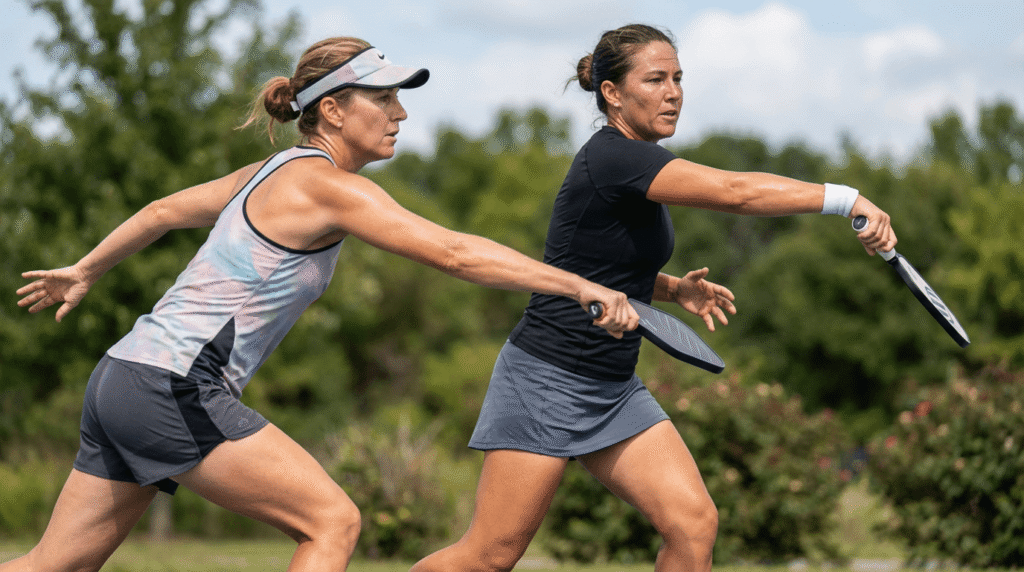
5.1. They Are Already Moving Before You Hit
This is the clearest sign. A player with good court awareness starts moving toward where the ball is going before it even leaves your paddle. That is not fast reflexes. That is anticipation built from reading your body position, paddle angle, and footwork before you have even swung.
It looks like they are cheating. They are not. They just read what you were about to do from information that was already available.
5.2. They Cover Space Automatically
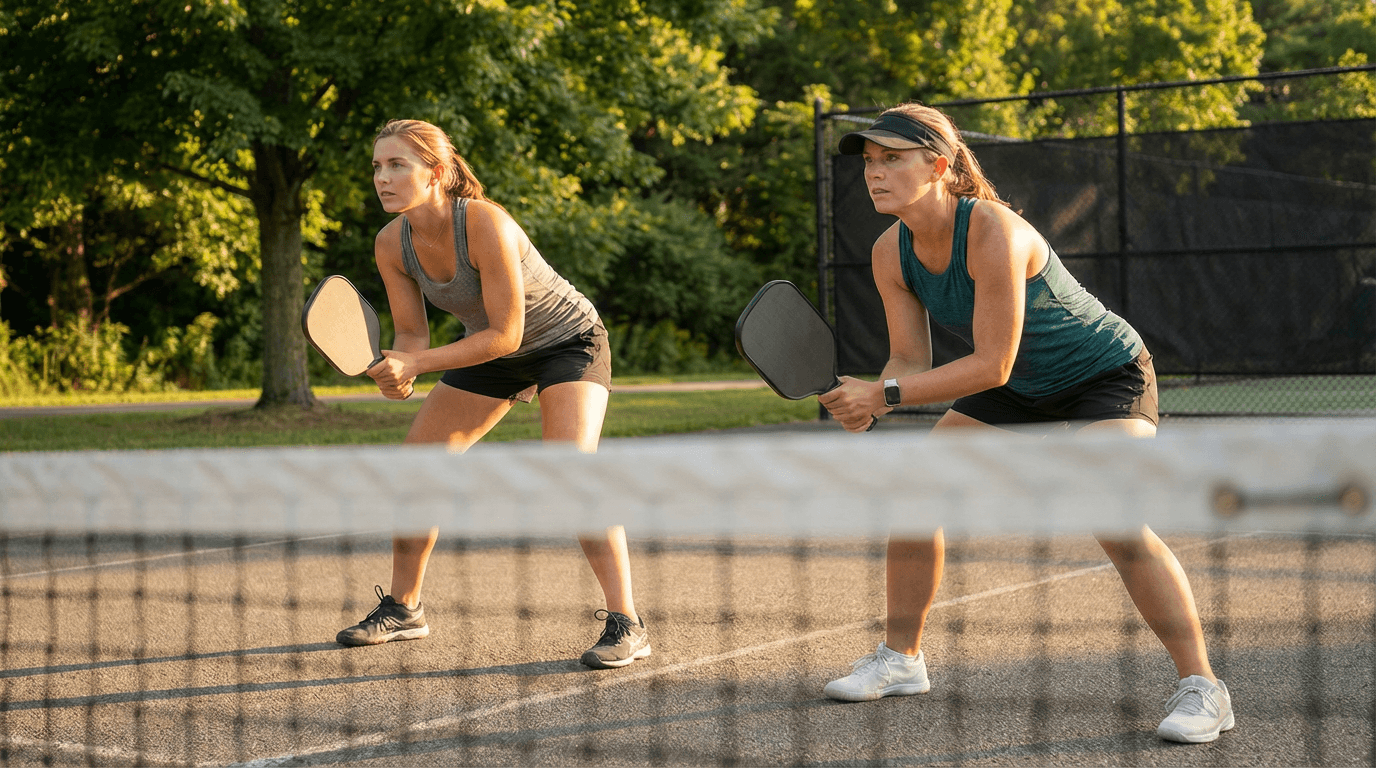
Good doubles partners shift together without talking. One moves right, the other fills the left. One goes wide, the other covers the middle. This is not something they planned in advance. It happens because both players are reading the same situation and responding to it. That automatic coverage comes from court awareness, specifically the part about tracking partner movement and adjusting.
5.3. They Know When to Attack and When to Wait
Players with court awareness make better decisions about when to speed up versus when to stay patient. They are not going on random balls. They are going when they see a gap, when an opponent is out of position, when the situation says this is the moment. And they are waiting when none of those conditions are present, even if the ball is technically hittable. That distinction between hittable and worth hitting is exactly what court awareness produces.
5.4. They Position Before the Ball Gets There
Watch where good players are standing when the ball arrives at them compared to average players. Good players are already in position. Average players are still getting there. The difference is that good players moved based on what they read in the previous shot. Average players waited to see where the ball went and then moved.
6. How to Start Building it
The good thing about court awareness is that you can start developing it today without changing a single thing about your technique. It is purely a focus and habit change.
6.1. Watch Your Opponents’ Feet, Not Just the Ball
Footwork tells you more about what shot is coming than almost anything else. A player whose weight is going backward is not going to attack. A player stepping into the ball with their shoulder turning is about to hit something with pace. A player shuffling laterally is off balance and probably going crosscourt. You do not need to be a body language expert. Just start noticing feet and weight shift and your anticipation will improve almost immediately.
Try this in your next session. Pick one opponent and spend the first game just watching their feet between shots. Not the ball. Their feet. You will be surprised how much information is there before they even swing.
6.2. Scan the Court Before Every Shot
Build the habit of a quick court scan during every ball flight toward you. The ball is in the air, you have a half second, use it. Where are both opponents? Where is your partner? Where is the gap? This does not have to be a detailed analysis. It is a fast sweep, like checking your mirrors while driving. It becomes automatic with practice.
Start with just one thing per point. First game, only scan for the near opponent’s position. Next game, look for the open space. Build it up gradually. Trying to track everything at once from the start is overwhelming and you will go back to watching just the ball.
6.3. Learn to Predict, Not Just React
Reaction is what happens when you have no information. Prediction is what happens when you have been paying attention. The goal of developing court awareness in pickleball is to get yourself out of reaction mode and into prediction mode on as many balls as possible.
After each rally, ask yourself one question. Did I know where that ball was going before it got there? If yes, what information told you? If no, what could you have looked at to know earlier? That simple reflection after points accelerates learning faster than any drill because it forces you to pay attention to what you were actually noticing.
It feels slow and deliberate at first. That is fine. The deliberate phase is how automatic habits get built.
7. A Simple Drill That Actually Works
Most drills do not build pickleball court awareness because they remove the decision-making. Here is one that keeps it in.
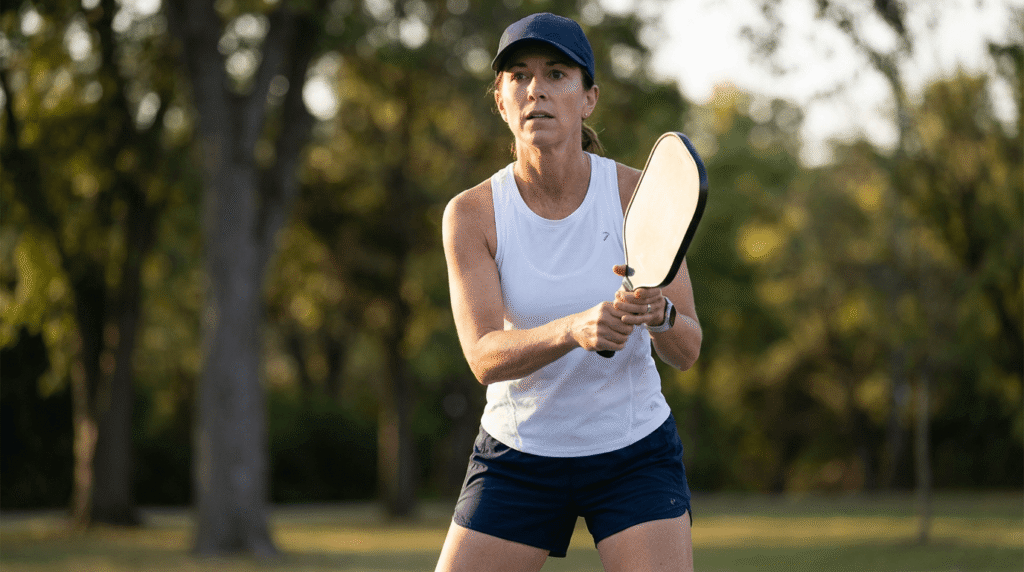
7.1. The Call It Drill
Play regular points but add one rule. Before you hit any ball you have to call out where you are aiming. Line, middle, or cross. You call it before you swing, not after. Your partner or opponent just listens, they do not adjust their position based on what you call.
This sounds simple and it is, but what it forces is a pre-contact decision every single time. You cannot call it after you have already swung. You have to know before. That requirement pushes you to scan the court and make a choice during the ball flight rather than reacting on contact.
Run this for one game per session. Do not worry about winning the points. Focus only on calling before you swing. After the game, think about how many times you could not call it in time. Those are the moments where your decision was happening at contact rather than before it. That is exactly what you are training out of yourself.
7.2. The Observation Point
Once a session, spend five minutes just watching a point without playing. Stand off to the side and watch two players in a rally. But instead of watching the ball, watch the players. Watch their feet, watch where they look, watch how they move between shots. Watch what position they are in when the ball arrives. You will see court awareness either present or absent almost immediately and it recalibrates what you look for in your own game.
8. What Changes When You Start Seeing the Whole Court
I want to be honest that this takes time. The first few sessions where you deliberately try to scan the court you will feel like your game gets worse because your attention is divided in a new way. That awkward phase is normal and it passes.
What comes after that phase is genuinely different from how the game felt before. Rallies feel less frantic. You start arriving at positions before the ball rather than chasing it. You notice gaps that you would have completely missed before. Decisions that used to feel rushed start feeling like they have room in them.
I had a partner last spring who I had played with a dozen times and always found the games close and a bit chaotic. We played a session where I focused specifically on tracking her position and the opponents’ positions throughout. We won more comfortably than we ever had and she said afterward that I seemed like I always knew where she was. She was right. I did. And that made us a completely different team than the one where I was just reacting to each ball.
That is the practical value of court awareness in pickleball. It is not a flashy skill. Nobody claps when you read the court correctly. But your partner feels it, your opponents feel it, and over the course of a match or a season it is the thing that compounds most.
You do not need a better serve to improve your game right now. You do not need a different paddle. You need to look up more. Watch more. Process more. The information is already there on every single point. You are just not collecting it yet.
Start collecting it. The difference it makes will surprise you.