
We’ve all seen it during Saturday Morning open play.
Two players are warming up on the far court. One is a human highlight reel—cannonball drives, heavy topspin, and a brand-new $250 carbon-fiber paddle that sounds different when it makes contact. The other looks… fine. They hit a standard ball. Their backswing is short. They aren’t “wowing” anyone.
Then the game starts.
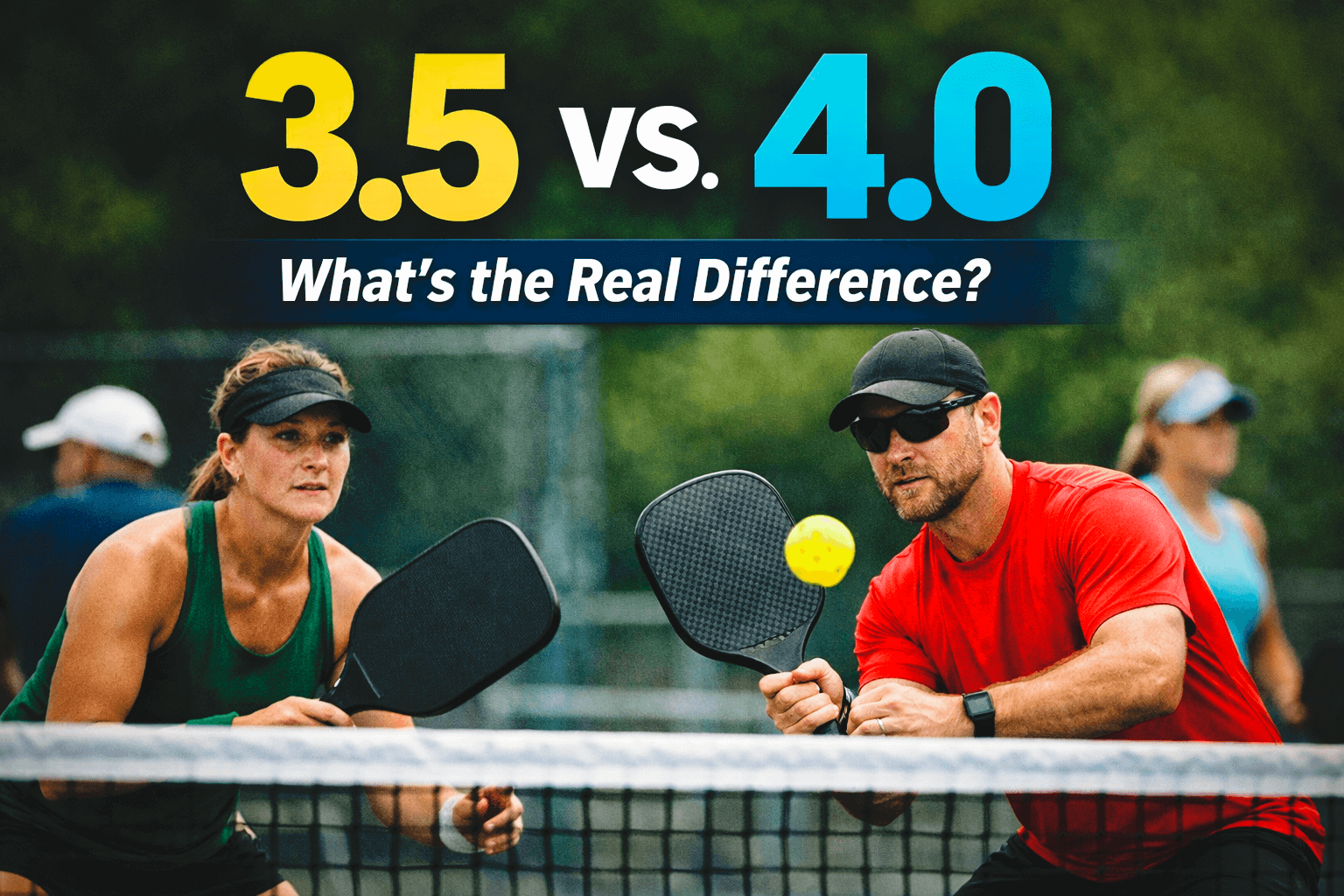
Ten minutes later, the flashy player is walking off the court after an 11-5 loss, shaking their head like something unfair just happened. That’s the 3.5 vs 4.0 pickleball difference in a nutshell.
If you’re stuck at the 3.5 level, you probably think the jump requires more power or a nastier serve. It doesn’t. In fact, 4.0 pickleball is actually much quieter than 3.5 play. The 3.5 vs 4.0 pickleball difference isn’t in your highlight shots—It’s in your discipline at the Non-Volley Zone (NVZ). It’s in how you handle transition pressure. It’s in whether you can stay patient when a rally gets messy instead of trying to rescue it with a hero swing.
At the 3.5 level, points often feel like a game of chicken — whoever hits it harder first usually wins (or misses). But at 4.0, the game becomes a system. It’s about managing transition pressure, forcing the one-more-ball mentality, and—most importantly—shot selection under fire.
The 4.0 jump isn’t about learning new tricks. Even the USA Pickleball guidelines tell you the jump to 4.0 is about keeping your head and staying consistent—not just hitting the ball harder. You already have the tools. Now, it’s about learning how to use them. Let’s break down the invisible structure that separates the hitters from the winners.
Table of Contents
1. The Power Myth: A Massive 3.5 vs 4.0 Pickleball Difference
The biggest trap in the 3.5-to-4.0 journey is the “Velocity Fallacy.” Most 3.5 players are convinced that if they could just add 10mph to their drive or 20% more snap to their overhead, the gates to 4.0 would swing open.
In reality, power without purpose is just a faster way to lose a point.
At the 3.5 level, power is often used as an escape hatch. When a player feels uncomfortable, or a rally goes on too long, they “bash” the ball just to end the tension. At the 4.0 level, power is a surgical tool. It isn’t used to end the point—it’s used to force a mistake. This mindset shift is a core 3.5 vs 4.0 pickleball difference that changes how you interact with the ball.
Here is the breakdown of how that mindset shift looks on the court:
Reactive. Triggered by impatience or a long dink battle.
Tactical. Triggered by a ball high enough to put away.
A bailout shot when caught out of position.
A setup shot designed to force a weak return.
Full swings that leave you wide open.
Short, compact punches that keep you balanced.
Aimed at the chest (easy to block).
Aimed at the feet or the open angle.
1.1. The Three-Second Rule
The 3.5 player treats a 15-shot rally like a ticking time bomb—they just want it to be over. The 4.0 player treats it like a game of chess. While the 3.5 player is thinking, “I have to do something spectacular,” the 4.0 player is thinking, “Just one more neutral ball.”
That extra three seconds of patience is often the only thing separating the winner from the loser. The gap isn’t measured in velocity—it’s measured in judgment.
2. Shot Selection Under Pressure: Who Blinks First?
Anyone can look like a pro during a casual Saturday morning warmup. But when the score hits 9–9 in a third-set tiebreaker? That’s when the court feels like it’s shrinking. Your palms get sweaty, the paddle feels like a lead weight, and your “inner 3.5” starts screaming at you to just end the point.
This is exactly where the 3.5 vs 4.0 pickleball difference becomes a total canyon. It’s not that your strokes suddenly fall apart—it’s just that your brain stops making good decisions. While the 3.5 is panicking, the 4.0 is leaning into the pressure and staying calm.
2.1. The “Panic Response” vs. The Disciplined Reset
At the 3.5 level, pressure triggers a panic response. Players feel an overwhelming urge to do something spectacular to “get it over with.” They go for the line, they speed up a ball that’s too low, or they try a “hero shot” they haven’t practiced in months.
Conversely, 4.0 players meet pressure with heightened discipline. They don’t try to win the point; they simply refuse to lose it.
Low Percentage. Tries a risky winner just to end the tension of the point.
High Percentage. Sticks to the cross-court dink and waits for the right opening.
Impatient. Grows frustrated and speeds up the ball prematurely out of exhaustion.
Endurance. Accepts that a single point might take 20+ shots to win properly.
Desperate Attack. Tries to hit down on a ball that is below the net (usually hits the net).
Soft Reset. Drops the ball back into the kitchen and waits for a “green light” ball.
Immediate Win. Believes they have to win the point “right now” with power.
One More Ball. Focuses solely on keeping the ball in play one more time than the opponent.
2.2. The “Boring” Path to the Podium
There’s a common saying in high-level pickleball: Pressure doesn’t create new weaknesses; it exposes existing ones.
If you have a habit of attacking balls from below the net during recreation play, that habit will turn into a liability at 10–10. The 4.0 player has trained themselves to override that “fight or flight” instinct. They understand that winning isn’t about brilliance—it’s about compounding high-percentage decisions.
One disciplined reset at 9–9 might not make the highlight reel, but three disciplined resets in a row will almost always force your opponent into a risky, losing shot.
The takeaway? Close games are rarely won by greatness. They are lost by impatience.
3. Transition Zone Discipline: Stop Running, Start Negotiating
In many 3.5-level games, the mid-court—infamously known as “No Man’s Land”—is treated like a floor made of lava. Players feel that if they don’t sprint to the kitchen line immediately, they’ve already lost the point.
This desperation to reach the net is exactly where the 3.5 vs 4.0 pickleball difference becomes most obvious.
At the 4.0 level, the transition zone isn’t a danger zone; it’s a workspace. Higher-level players don’t panic when they’re caught mid-court. They don’t lunge, and they certainly don’t sprint blindly into a drive. Instead, they negotiate their way forward using split-steps, soft resets, and balance.
3.1. The “Rush” vs. The “Negotiation”
The difference between a 3.5 and a 4.0 in the transition zone comes down to one thing: Stability.
Sprints to the net even if the drop is high or shallow.
Pauses and holds position if the drop doesn’t force a “down” contact.
Resets the ball softly into the kitchen to neutralize.
Absorbs the energy and drops the ball softly into the kitchen.
Lunges while running, leading to pop-ups or net errors.
Split-steps. Stops, balances, and plays a neutral ball.
Feels they must reach the kitchen in one single shot.
Patiently takes 2–3 shots to advance safely.
You Don’t Earn the Kitchen—You Negotiate It
The hallmark of transition maturity is “The Pause.”
A 4.0 player understands that the Kitchen line is a privilege, not a right. If their third-shot drop is a bit “fat” or high, they don’t charge forward into the line of fire. They stay back, defend the next ball, and wait for a better opportunity to move up.
They prioritize balance over urgency and control over speed. They know that if they can’t get to the line safely in one shot, they’ll just take three. By the time they finally reach the NVZ, the point is neutralized, the chaos is gone, and they are ready to dink.
4. Reset Ability: The Art of De-Escalation
Most 3.5 players spend hours drilling the third-shot drop, believing it’s the only way to reach the kitchen. But the real “secret sauce” of a 4.0 player isn’t just the third shot—it’s the mid-rally reset.
While a 3.5 player treats a hard-hitting exchange like a fire they need to fight with more fire, the 4.0 player acts as the fire extinguisher. This is the ability to take a ball that is traveling 40 mph and “dead-ball” it into the kitchen, forcing the opponent to stop attacking and start dinking.
4.1. The Escalator vs. The Neutralizer
In pickleball, “de-escalation” is a superpower. Here is how the levels handle high-velocity pressure:
Swings hard at a fast ball; adds more chaos to the rally.
Absorbs the pace and kills the ball’s energy into the kitchen.
Blocks the ball back deep and hard, inviting another drive.
“Catches” the ball with a loose grip to reset the point.
Lunges and flails, usually resulting in a high pop-up.
Maintains a stable base and uses “soft hands” to soften contact.
Counter-attacks out of panic, even when out of position.
Calmly neutralizes the speed to regain control.
4.2. Control Beats Reaction—Every Time
The defining 3.5 vs. 4.0 difference is the loose grip. At the 3.5 level, when a “hard ball” comes, a “hard ball” almost always goes back. This leads to reactive, “bang-bang” rallies where the winner is usually decided by luck or a net cord. A 4.0 player understands that they don’t have to win the hand battle—they just have to end it.
They have developed the “soft hands” required to:
- Absorb Pace: Using a “grip tension of 3 out of 10” to take the sting out of an opponent’s drive.
- Neutralize Speed-ups: Turning an aggressive attack back into a “boring” dink.
- Reset from Anywhere: Finding the kitchen on the 7th, 11th, or 15th shot—not just the 3rd.
Instead of escalating the chaos, the 4.0 player waits. They know that by resetting the ball, they are asking the opponent a difficult question: “Are you disciplined enough to start dinking, or are you going to beat yourself by trying another low-percentage attack?”
5. The Power of the “Boring” Ball
In the highlight-reel world of YouTube and Instagram, consistency is rarely celebrated. It’s not flashy, and it doesn’t look “cool.” But in competitive play, extreme consistency is devastatingly effective.
The most profound 3.5 vs. 4.0 pickleball difference is found in how a player handles the “unimpressive” shots. While a 3.5 player feels they need to do something with every ball, the 4.0 player is perfectly content doing absolutely nothing—except keeping the ball in play.
5.1. Boredom: The Great Separator
At the 4.0 level, patience isn’t just a virtue; it’s a weapon. Here is how that mental shift translates to the score sheet:
Gets “itchy” and forces a low-percentage attack just to change the pace.
Embraces the grind; trusts the cross-court pattern and waits for a genuine opening.
Tries to end points early to avoid the discomfort of a long dink battle.
Comfortable living in “neutral” for 20+ shots without feeling the need to speed up.
Fishes for lines or extreme angles prematurely, often hitting into the net.
Focuses on high-percentage, unattackable dinks that keep the opponent pinned back.
Beats themselves by committing unforced errors out of frustration.
Outlasts the opponent’s patience and wins by being the more disciplined player.
5.2. Using Patience as a Weapon
4.0 players understand a fundamental truth: You don’t need every shot to win the rally; you just need every shot to be safe.
Every safe, “boring” dink acts as a psychological test for your opponent. It forces them into decision fatigue. By hitting one more unattackable ball, you are asking them: “Are you disciplined enough to stay in this neutral rally, or are you going to blink first and force a speed-up?“
5.3. Most players eventually blink.
That is why 4.0 rallies feel long, structured, and controlled. It isn’t passive play—it’s disciplined aggression. You are aggressively taking away your opponent’s options until the only thing they have left is a risky, “hopeful” shot.
6. Speed-Up Timing: Tactical Aggression vs. “Hopeful” Hitting
In pickleball, a speed-up should be a tool—not a reflex. The defining 3.5 vs. 4.0 pickleball difference isn’t how fast you can swing your paddle; it’s the “green light” you wait for before you pull the trigger.
At the 3.5 level, speed-ups are often reactive. A player gets a ball that looks “fast enough” and they swing, regardless of the ball’s height or their own court position. At the 4.0 level, a speed-up is strategic. It is the final step in a point that has been carefully built.
6.1. Strategic Speed-ups: The “Green Light” Filter
Knowing when to accelerate the ball is what separates the winners from the “bangers.”
Often below the net, making the attack easy to counter-attack or smash back.
Shoulder-high contact. Targeted to keep the ball trajectory moving downward toward the opponent.
Attacks balls drifting wide, which accidentally opens up your own court for a cross-court counter.
Attacks balls in the middle (the “Center T”) to create communication confusion between opponents.
Often done out of pure impatience or frustration during a long, disciplined dink rally.
Triggered by a specific tactical opening, such as an opponent being caught out of position or off-balance.
Usually a “hopeful” shot that often leads to a defensive scramble after a strong counter-attack.
A calculated strike designed specifically to end the point immediately or force a weak pop-up.
6.2. The “Obvious vs. Hopeful” Test
The mental shift is simple: A 4.0 player builds the point before attacking, while a 3.5 player attacks and hopes the point will somehow build itself.
You can audit your own level with one simple question after a rally ends: “Was that ball clearly attackable?“
If your answer is “maybe,” it probably wasn’t. 4.0 players rarely attack “maybe” balls—they wait for the “obvious” ones. By eliminating the “hopeful” speed-up from your game, you remove the #1 source of unforced errors. Over the course of a match, that single filter—obvious vs. hopeful—is often the difference between an 11–9 win and an 8–11 loss.
7. Court Awareness: From Individual Play to Team Systems
One of the most underrated 3.5 vs. 4.0 pickleball differences is how players view the space around them. At the 3.5 level, players are often “ball-focused”—they see the ball, they hit the ball, and they worry about their own feet.
At the 4.0 level, “Court IQ” takes over. Players stop thinking as individuals and start moving as a system. If you watch a 4.0 duo, they look like they’re connected by an invisible bungee cord. When one moves wide, the other slides to cover the middle. When one stays back, the other checks their shoulder. This systemic movement eliminates the “easy points” that usually sink 3.5 teams.
7.1. Individual Mindset vs. Systemic Awareness
Mostly on the ball and the net; misses the subtle cues of the game.
On the ball, the opponent’s paddle face, and player positioning to anticipate the next shot.
“Mine or yours?” Hesitation creates gaps that opponents easily exploit.
The middle is claimed early and confidently as a strategic priority for the team.
Static; often stays in their “lane” regardless of where the ball is on the court.
Fluid; shades toward the ball as a unit to shrink the court and eliminate angles for the opponent.
Focused solely on making their own “good” shot or highlight play.
Focused on creating a “bad” shot for the opponent by systematically taking away their best options.
7.2. Recognizing the Invisible Patterns
A 4.0 player isn’t just reacting to the ball; they are reading the script of the match. They recognize patterns that 3.5 players often miss:
- The Tells: Recognizing that an opponent’s backswing is too big, signaling a drive before it happens.
- The Weakness: Identifying the partner with the “shaky” backhand and isolating them under pressure.
- The System: Knowing when to cover the middle and when to give up the sideline “alley” to protect the high-percentage center.
This coordination leads to less hesitation and fewer “You take it—no, you take it” moments. By moving as a system, 4.0 players prevent the “cheap” points—those unforced errors caused by confusion—that almost always decide the outcome of a close game.
8. The 9–9 Tiebreaker: Composure as a Skill
If you’ve ever felt your heart rate spike when the score hits 9–9, you aren’t alone. But have you noticed that 4.0 players seem to get quieter as the game gets tighter?
This isn’t a personality trait—it’s a developed skill.
The most overlooked 3.5 vs. 4.0 pickleball difference is emotional regulation. At the 3.5 level, a missed “sit-up” overhead often triggers a “death spiral”—one error leads to frustration, which leads to a rushed serve, which leads to a lost game. A 4.0 player has trained themselves to “reset” as effectively as they reset a hard drive.
8.1. Panic vs. Composure: The Internal Scoreboard
Dwells on the mistake; enters a “death spiral” of declining confidence.
Short memory. The error is deleted and forgotten before the next serve.
Frustration speeds up the tempo; everything feels rushed and chaotic.
Maintains a rhythmic, controlled pace between points to stay grounded.
Lets fear dictate the shot, often resulting in over-swinging or timid play.
Decision-making remains stable and tactical, regardless of the score or pressure.
Tight muscles and shallow breathing drain stamina and hinder fluid movement.
Uses intentional breathing to keep muscles loose and maintain high energy levels.
8.2. Managing the Self to Manage the Ball
The truth is that 4.0 players feel the exact same pressure you do. The difference? They don’t let that pressure choose their shots.
Emotional control is actually an energy-saving device. When you get frustrated, your muscles tighten, your breathing becomes shallow, and you burn through your “focus fuel” twice as fast. A 4.0 player manages themselves as much as they manage the ball. They:
- Take the full 10 seconds: They don’t rush the next serve when they’re annoyed.
- Breathe: They use the walk to the baseline to lower their heart rate.
- Detach: They treat a 10–10 point exactly the same as a 0–0 point.
That internal regulation is invisible to the crowd—but it’s the reason they’re the ones shaking hands at the net with the win.
9. The Open Play Optical Illusion: Addition by Subtraction
If you pull up a chair and watch a strong 4.0 open play group, you might be surprised by what you see—or rather, what you don’t see.
The 4.0 player doesn’t necessarily hit the ball harder or move faster than the 3.5 player. In fact, they often look like they’re doing much less. This is the “Addition by Subtraction” phase of pickleball. You notice a 4.0 player not for their highlight-reel winners, but for the mistakes they simply stop making.
9.1. The “Anti-Highlight” Reel: What 4.0s Don’t Do
While the 3.5 player is busy trying to “make plays,” the 4.0 player is busy staying balanced.
Forces an attack on a ball at their shoelaces, often resulting in errors.
Never. They dink the ball and wait for a higher, more attackable look.
Rushes the net recklessly, hoping to reach the line before the next ball arrives.
Negotiates the entry with 2–3 patient resets to ensure they are balanced.
Constantly hunts for the sideline or sharp angles to end the point early.
Ignored in favor of the “boring,” high-percentage deep ball down the middle.
Characterized by flailing, lunging, and desperation swings that leave the court open.
Remains compact and intentional, making small, balanced adjustments to stay in position
9.2. Economy of Motion: Why They Never Look Rushed
Have you ever played someone who always seems to be exactly where the ball is, without ever appearing to run? That is Economy of Motion. The 4.0 game feels “simple” because it is controlled. Because they don’t over-swing, they don’t lose their balance. Because they don’t lose their balance, they recover for the next shot twice as fast as a 3.5 player.
There are no desperation heaves or “flailing” lunges. Instead, there are compact, rhythmic adjustments. This efficiency doesn’t just save energy—it buys time. And in a game as fast as pickleball, time is the ultimate currency. The player who looks the least rushed is usually the one who is actually winning.
10. Plugging the Leaks: Your Blueprint to 4.0
Closing the gap between 3.5 and 4.0 is rarely about adding “weapons.” You don’t need a 60-mph drive or a behind-the-back flick. What you need is a cleaner scorecard.
To reach the next level, stop looking for more shots and start looking for fewer poor decisions. Here is your tactical checklist to stop leaking points and start playing 4.0 pickleball.
10.1. Master the “Soft Reset”
Most players practice third-shot drops in a vacuum, but the 4.0 game requires “soft hands” in the heat of a battle.
- The Drill: Instead of trying to out-fire a banger, practice absorbing their pace.
- The Goal: If you can consistently neutralize a hard drive into a “boring” dink, you have effectively stripped your opponent of their only weapon.
10.2. Audit Your Transition Footwork
If you want to see why you’re losing points mid-court, record yourself. You’ll likely notice a trend: you’re hitting volleys while your feet are still moving.
- The Split-Step: Stop the “sprint-and-pray.” If your feet are still moving when your opponent hits the ball, you’re toast. Most transition errors aren’t bad strokes—they’re just the messy result of hitting while off-balance. Plant your feet before they swing, even if you’re still mid-court.
10.3. Apply the “Above-the-Tape” Filter
Create a non-negotiable rule for yourself: If the ball is below the net, you are not allowed to speed it up. If you’re wondering, “Can I attack this?” the answer is almost always no. By only attacking balls clearly above net height, you eliminate the “hopeful” shots that usually end up in the net or off the back line.
10.4. Weaponize Your Return Depth
A shallow return is an invitation for a 4.0 opponent to crush you. Deep returns buy you the one thing you need most: Time. Keep your returns high, soft, and deep. It simplifies your transition and forces your opponent to hit a much more difficult third shot.
10.5. The 3-Point Audit
Forget about the score for your next session. Just keep a “mental tally” of where you’re actually losing points. Chances are, 80% of your mistakes will fall into one of these three buckets:
- Bashing Low Balls: How many times did you swing hard at something below your waist? (Hint: If you’re hitting the tape, that’s why.)
- The “Moving” Volley: Did you get caught with your feet in mid-air while trying to reset in transition?
- Impatience Pops: Did you speed up a boring dink just because you were tired of waiting?
If you can stop doing those three things, your rating will jump almost overnight. It’s not about finding new “weapons”—it’s just about getting rid of the stuff that’s killing your game. To truly master the 3.5 vs 4.0 pickleball difference, you need to remove the above three leaks.
11. Final Thoughts: The Art of Doing Less
Look, if you’re hitting a wall at 3.5, it’s rarely about your talent or your paddle. And trust me, more power isn’t the answer. Usually, you just have a ‘decision‘ problem.
At 3.5, the game feels like a panic attack. You’re scrambling, you’re speeding up balls out of desperation, and you’re charging the net like the floor is made of lava. 4.0 play is just… quieter. While the 3.5 player is trying to ‘win’ the point with a miracle shot, the 4.0 player is just chilling, resetting the ball, and waiting for you to beat yourself. They aren’t playing harder; they’re just playing smarter.
The jump to 4.0 feels mysterious because it’s measured by what doesn’t happen. It’s the low-ball attack you didn’t take. The transition you didn’t rush. The “hero shot” you didn’t try at 9–9.
The best part? You don’t need a nastier serve or a harder overhead to get there. You just need to notice that split second where your instinct says “attack”, and your brain knows better. Stop trying to make the game more complex. At the end of the day, the 3.5 vs 4.0 pickleball difference isn’t about adding complexity to your game—it’s about simplifying it
Clean up the messy transitions, stop the “hopeful” speed-ups, and keep your head when the score gets tight. The gap will close—one boring, disciplined rally at a time.